
Benefits of Pyrroloquinoline Quinone (PQQ Supplement)
You know the frustrating pattern: you train hard, you clean up your diet, and you still get hit with low energy and brain fog. A PQQ supplement (pyrroloquinoline quinone) gets attention because it supports mitochondrial function, and it is also studied for metabolic markers tied to insulin sensitivity.
PQQ acts as a cofactor for redox enzymes, and it can also behave like a potent antioxidant, which is why it shows up in research on oxidative stress and cellular energy.
If you are someone who cares about your health, the practical question is simple: what does PQQ actually do in humans, how do you use it, and how do you pick a quality bottle?
Below, I will break down the mechanisms, the most useful human health studies on PQQ and research on PQQ, potential benefits, food sources, dosage and safety, and what to look for on a label.
Disclaimer: This article is for informational purposes only and is not meant to treat or diagnose any condition. It is recommended that you speak with your doctor before starting any exercise program, changing your daily nutrition, or adding any supplements to your regimen.
Table of contents
- What is Pyrroloquinoline Quinone (PQQ)?
- How Does PQQ Work in the Body?
- Key Health Benefits of PQQ Supplements
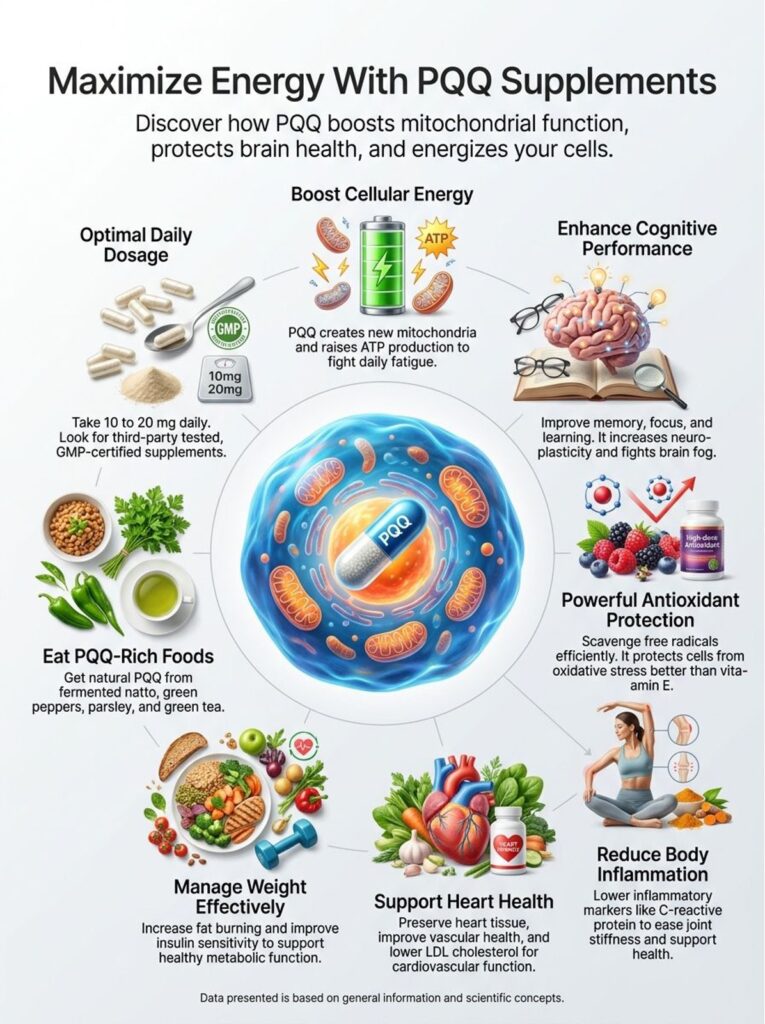
- How Does PQQ Boost Cellular Energy Levels?
- Can PQQ Enhance Cognitive Performance?
- How Does PQQ Support Brain Health and Neuroprotection?
- How Does PQQ Reduce Inflammatory Responses?
- What Are the Effects of PQQ on Heart Health?
- Does PQQ Promote Longevity and Anti-Aging?
- Can PQQ Aid in Weight Management?
- How Does PQQ Increase Insulin Sensitivity?
- Can PQQ Help Prevent Metabolic Syndrome?
- PQQ’s Impact on Specific Health Conditions
- Natural Sources of PQQ
- What Is the Recommended Dosage and Safety of PQQ Supplements?
- How to Choose a High-Quality PQQ Supplement
- PQQ and PQQ Supplements May Be a Great Addition to Your Routine
- FAQs on PQQ Supplements
Key Takeaways
- PQQ (methoxatin) is a redox-active molecule that can influence mitochondrial biogenesis signaling (PGC-1α/CREB) and antioxidant defenses, which is why it is popular for mitochondrial health and cellular energy.
- Human studies commonly use 20 mg per day for 6 to 12 weeks, with published trials reporting improvements in select cognitive measures and changes in inflammation-related markers.
- Food sources contain tiny amounts (measured in ng/g in many foods), so dietary intake is not comparable to a typical PQQ supplement dose.
- Safety is dose-dependent: high-dose animal studies flag reversible kidney findings, while human studies use much lower intakes. If you have diabetes, kidney disease, or autoimmune concerns, talk with your clinician before you supplement.
What is Pyrroloquinoline Quinone (PQQ)?
Pyrroloquinoline quinone (PQQ), also called methoxatin, is a small, redox-active o-quinone. In plain terms, it is a molecule that can participate in electron transfer, which is why researchers pay attention to it in energy metabolism, oxidative pathways, and mitochondrial function.
You will usually see PQQ sold as pyrroloquinoline quinone disodium salt. That form tends to be easier to manufacture consistently and easier to dose.
Food contains PQQ, but at very low levels. In an FDA GRAS notice that summarizes measured food concentrations, PQQ in common foods is typically reported in the ng/g range (for example, natto around 61 ng/g and parsley around 34.2 ng/g), which helps explain why supplements are measured in milligrams, not micrograms.
PQQ also exists in oxidized and reduced forms (often described as PQQox and PQQH2). That matters because redox cycling is a big part of why PQQ is studied as an antioxidant molecule.
What the label terms actually mean
- PQQ: the base molecule, often discussed in studies on oxidative stress and mitochondrial function.
- PQQ disodium salt (PQQNa2): a common supplemental form used in many human studies.
- PQQH2: the reduced form, often described as having strong antioxidant activity in lab work.
- Mitochondrial biogenesis: your cells increase the number and capacity of mitochondria, which can support training adaptations over time.
How Does PQQ Work in the Body?
PQQ is interesting because it does not act like a stimulant. It is studied more like a cellular support molecule, affecting mitochondria, redox balance, and cell signaling pathways linked to inflammation and metabolic function.
If you are shopping, you will see PQQ sold alone or stacked with ingredients like CoQ10. The logic is straightforward: PQQ relates to mitochondrial biogenesis signaling, while CoQ10 is part of mitochondrial electron transport.
| What PQQ may influence | Why fitness-minded people care | How to make it actionable |
|---|---|---|
| Mitochondrial biogenesis signaling (PGC-1α and related pathways) | Supports the cellular changes you want from consistent training blocks | Use it during a structured endurance or conditioning phase, then evaluate energy, recovery, and training consistency |
| Oxidative stress balance (antioxidant effects in lab and short human studies) | Hard training raises oxidative load, especially under sleep debt or calorie cuts | Do not chase mega-doses, focus on steady use and track how you feel and perform |
| Inflammation-related markers (short human trials) | Inflammation can show up as poor recovery, low motivation, or nagging soreness | If you do labs, consider tracking a baseline and follow-up hs-CRP with your clinician |
How Does PQQ Promote Mitochondrial Biogenesis?
PQQ is best known for its connection to mitochondrial biogenesis, largely through signaling pathways that involve CREB and PGC-1α. Those signals can push the cell to build more mitochondrial capacity, which is a central goal for endurance, conditioning, and long-term metabolic fitness.
A useful reality check for athletes comes from a 2020 randomized controlled trial in untrained men: 23 participants took 20 mg per day of PQQ or placebo while completing a supervised six-week endurance training program. The study did not find an added boost in aerobic performance from PQQ, but it did report higher PGC-1α protein levels in the PQQ group, which supports the idea that PQQ can influence mitochondrial biogenesis signaling in the context of training.
- If your goal is endurance performance, treat PQQ as a support, not a shortcut. The training stimulus still drives the outcome.
- If your goal is mitochondrial adaptation, use PQQ consistently during a focused training block, then reassess after several weeks.
- If you feel nothing, that is not a surprise. The study signals were biochemical (PGC-1α), not a guaranteed performance jump.
What Are the Antioxidant Effects of PQQ?
PQQ shows strong antioxidant properties in lab models, and that is one reason it is discussed in oxidative stress research. The key practical point is not that PQQ is “the best antioxidant,” it is that it is redox-active and can cycle through reactions in ways many antioxidants cannot.
In a 2013 crossover study from the University of California, Davis, participants took PQQ in two ways: a single dose of 0.2 mg per kg (with changes tracked over 48 hours), and a short multi-day intake of 0.3 mg per kg per day (with inflammation-related markers assessed after 76 hours). The study reported changes in TBAR-related assessments and decreases in plasma C-reactive protein and IL-6 during the multi-day intake.
If you are sensitive to supplements, the most common mistake is starting too high, too fast. Many users informally report nausea or headaches at 20 mg on an empty stomach, then do better with a lower starting dose or taking it with food.
How Does PQQ Regulate Cellular Functions?
PQQ is studied for effects that go beyond one pathway. In research models, it is linked to signaling routes involved in metabolism, inflammatory control, and cellular stress response, which is why you will see it discussed in topics like mitochondrial dysfunction and chronic oxidative stress.
That same 2013 UC Davis human study also reported shifts in urinary metabolites consistent with enhanced mitochondria-related functions, plus decreases in certain methylated amines (including trimethylamine N-oxide). For a fitness audience, the “so what” is simple: PQQ is not only about energy, it is also about how cells handle stress and recovery.
Key Health Benefits of PQQ Supplements
The benefits of PQQ are usually framed around mitochondria: more capacity, better resilience to oxidative stress, and smoother cellular energy production. The strongest reader-friendly approach is to separate what human studies suggest from what is still based on animal or lab work.
- Best supported in humans: select cognitive measures, short-term changes in inflammation-related markers, and certain lipid changes in a subgroup with elevated LDL.
- Promising but not settled: body composition changes, weight loss, and long-term longevity outcomes.
Some PQQ supplements to consider include:
How Does PQQ Boost Cellular Energy Levels?
PQQ is often marketed for “energy,” but the mechanism is not the same as caffeine. The practical story is mitochondrial: if PQQ supports mitochondrial biogenesis signaling, and mitochondria make ATP, you may notice steadier energy during the day or less drag in training weeks where recovery is tight.
For those who exercise regularly, the 2020 endurance training trial is a useful guide. It used 20 mg per day alongside a six-week training program and found no direct ergogenic effect on aerobic performance, but it did show higher PGC-1α protein levels in the PQQ group. That points to “cellular adaptation support” more than “instant performance booster.”
- Track energy like a performance variable: sleep quality, training consistency, and perceived recovery.
- If you want a clear test, run a simple 6 to 8-week block and keep your other variables steady.
Can PQQ Enhance Cognitive Performance?
This is where human studies are more compelling than most people expect. Cognitive benefits are one of the main reasons PQQ shows up in nootropic stacks.
In a 2023 double-blind, placebo-controlled study in adults aged 20 to 65, researchers gave 20 mg per day for 12 weeks and reported improvements in composite memory and verbal memory. An earlier 2016 randomized, placebo-controlled trial in elderly healthy adults also used 20 mg per day for 12 weeks and reported improvements in measures tied to selective attention.
- If brain fog is your main issue, test PQQ during a work block, not a deload week, so you can tell what is real.
- If sleep is disrupted, take it earlier in the day at first and watch your response.
How Does PQQ Support Brain Health and Neuroprotection?
Preclinical studies suggest PQQ can influence pathways linked to neuroprotection, including oxidative stress control and protein aggregation behavior. You will see discussions about amyloid β and α-synuclein in lab work.
For a practical, fitness-focused takeaway: the more your lifestyle leans into sleep debt, high stress, and aggressive dieting, the more you should treat “brain support” as a whole system. PQQ may help, but it works best as a small part of a consistent routine.
How Does PQQ Reduce Inflammatory Responses?
PQQ is discussed in inflammation partly because oxidative stress and inflammation feed into each other. In hard training phases, you may feel that loop as soreness that lingers or a sense that recovery is stuck.
In the 2013 short human crossover study, PQQ supplementation was associated with decreases in C-reactive protein and IL-6 over a multi-day intake period, even though standard clinical indices like cholesterol and glucose were not altered in that brief window. This is a useful frame: you may see subtle recovery-related benefits even when headline lab numbers do not move fast.
What Are the Effects of PQQ on Heart Health?
The heart health story for PQQ is a mix of antioxidant logic, animal data, and a small set of human results.
One human trial from 2015 used 20 mg per day for 12 weeks in 29 healthy adults (ages 40 to 57). In the subgroup that started with elevated LDL (at or above 140 mg/dL), LDL decreased significantly compared with placebo, and the full group showed a modest LDL drop (from 136.1 to 127.0 mg/dL) in the PQQ group. If you are already tracking lipids, this gives you a clear way to evaluate whether PQQ is doing anything for you.
- If LDL is a concern, treat PQQ as a supplement, not a replacement for a clinician-led plan.
- Run a before-and-after lipid panel only if your diet and training are stable, otherwise you will not know what caused the change.
Does PQQ Promote Longevity and Anti-Aging?
Longevity claims for PQQ mostly come from animal and cell studies tied to mitochondrial biogenesis and oxidative stress resilience. These are interesting signals, but they are not the same thing as proving a longevity benefit in humans.
RELATED: NAD3 — Natural NAD Supplement for Cellular Longevity
If you care about healthy aging as an athlete, the most useful way to view PQQ is as a “mitochondrial support” tool. It can complement the big levers, training, protein intake, sleep, and cardio-respiratory fitness.
Can PQQ Aid in Weight Management?
PQQ is sometimes promoted for fat loss because mitochondria influence fat oxidation and metabolic flexibility. Most of the stronger fat-loss style findings are still based on animal work.
If you try PQQ for weight management, do it the same way you would test any supplement: keep calories, protein, and training consistent for several weeks and watch trend data like waist measurement, training performance, and hunger, not day-to-day scale swings.
How Does PQQ Increase Insulin Sensitivity?
PQQ is sometimes linked to insulin sensitivity because it intersects with mitochondrial function, oxidative stress, and inflammation, all of which can shape metabolic health.
That said, human evidence is still limited. In the 2013 short human crossover study, standard clinical indices such as glucose were not altered during the brief study window, even while inflammation-related markers shifted.
If you have insulin resistance or diabetes, the safe move is to treat PQQ as a “discuss with your clinician” supplement, then monitor your usual markers.
Can PQQ Help Prevent Metabolic Syndrome?
Metabolic syndrome is a clinical diagnosis built from several risk markers, and PQQ is not a treatment.
The most honest position is this: PQQ may support mitochondrial function and oxidative stress balance, and those relate to metabolic health, but large, long-term human trials for metabolic syndrome outcomes are not established.
If your goal is metabolic health, use PQQ as a small add-on to the basics that work: consistent training, enough sleep, and a diet that supports your body composition goals.
PQQ’s Impact on Specific Health Conditions
PQQ research often shows up in discussions about mitochondrial dysfunction, oxidative stress, and lipid metabolism. These are real biological themes, but it is still important to keep claims grounded in what is tested in humans.
How Does PQQ Enhance Mitochondrial Health?
PQQ is studied as a driver of mitochondriogenesis through pathways that include PGC-1α and downstream targets tied to mitochondrial gene expression. It is also discussed as a cofactor molecule in quinoprotein biology, which is part of why it shows up in energy metabolism research.
For athletes, the cleanest interpretation is the training-plus-supplement model: the six-week endurance training trial using 20 mg per day showed a biochemical shift (higher PGC-1α protein content) without a guaranteed performance boost. That is exactly what “mitochondrial support” often looks like in the real world.
How Does PQQ Protect Against Oxidative Stress?
PQQ can scavenge free radicals, and it can participate in redox cycling, which is why it is studied in oxidative stress models. The reduced form (PQQH2) is often described as especially active in lab work.
If you want an action step that matches the science, focus on steady dosing and conservative expectations. The strongest human signals so far come from short studies measuring oxidative and inflammation-related markers, not from long-term disease endpoint trials.
What Role Does PQQ Play in Supporting Lipid Metabolism?
Lipid metabolism claims for PQQ often come from animal models, where shifts in oxidative stress and mitochondrial pathways can change lipid handling.
The best human anchor is still the 2015 12-week trial that saw LDL lowering in a subgroup with higher baseline LDL. If lipid metabolism is your goal, you will get more clarity from tracking a lipid panel than from trying to “feel” the effect.
Could PQQ Have Potential in Cancer Prevention?
Some lab studies explore PQQ in cancer-related models, including apoptosis signaling. That is early-stage research, not a reason to use PQQ as a cancer prevention strategy.
If you have a cancer history, are in treatment, or are in surveillance, bring any supplement plan to your oncology team first. The risk is not just the molecule, it is interactions, contamination risk, and the chance you delay evidence-based care.
How Does PQQ Promote Cellular Health?
Cellular health is the umbrella term people use for energy, recovery, and resilience. PQQ fits that theme because it is studied for mitochondrial function, oxidative balance, and inflammation-related signals.
- Training support: aligns with mitochondrial biogenesis signaling, which matters most when you train consistently.
- Recovery support: fits the oxidative stress and inflammation conversation, especially in high-volume blocks.
- Cognitive support: human trials suggest benefits in select memory and attention measures at 20 mg per day.
RELATED: Telomere Shortening — Its Role in Cancer and the Aging Process
Natural Sources of PQQ

You can find PQQ in fruits and vegetables, as well as fermented foods. Food sources matter for diet quality, but they do not deliver the milligram-level doses used in most supplement studies.
If you want both, use foods for baseline nutrition and consider supplements for a measured dose.
Which Foods Are High in PQQ?
In a US FDA GRAS notice summarizing measured food content, many foods contain PQQ in the ng/g range. Here are examples people actually eat, with reported concentrations.
| Food | Reported PQQ concentration | Practical takeaway |
|---|---|---|
| Fermented soybeans (natto) | About 61.0 ng/g | One of the higher reported food sources, still a micro-dose compared with supplements |
| Parsley | About 34.2 ng/g | Easy add-on for meals, but the dose is tiny |
| Kiwi fruit | About 27.4 ng/g | Useful food source, still far below supplement dosing |
| Spinach | About 7.0 to 21.9 ng/g | Worth eating for many reasons, PQQ is a bonus |
| Green tea | About 0.16 to 29.6 ng/g | Wide range reported, treat it as a small contributor |
Are Fermented Products Good Sources of PQQ?
Fermented foods can be useful PQQ sources because microbes are involved in PQQ biology. In the same FDA GRAS summary tables, natto is listed as a higher PQQ food, and miso and tofu also appear with measurable amounts.
- Add natto, miso, or tempeh if they fit your diet and digestion.
- If you want a consistent, study-like intake, a PQQ supplement is the measured option.
What Is the Recommended Dosage and Safety of PQQ Supplements?
The most common evidence-based starting point is to mirror what human studies actually used. Many published human trials use 20 mg per day of pyrroloquinoline quinone disodium salt for periods like 6 to 12 weeks.
Safety becomes a question when people push doses far beyond what is studied, or when they have kidney disease or complex medical issues.
An EFSA safety opinion for PQQ disodium salt reported a no-observed-adverse-effect level (NOAEL) of 100 mg per kg body weight per day in a 90-day rat study and concluded that the margin of exposure was considered sufficient for the proposed intake level.
What Are the Guidelines for Daily PQQ Intake?
- Pick a study-aligned dose: many human trials use 20 mg per day, so that is a reasonable reference point for a healthy adult.
- Start lower if you are sensitive: consider 5 to 10 mg per day for the first week, then increase if you tolerate it well.
- Give it time: PQQ is not a pre-workout. Plan to evaluate it over weeks, not days.
- Do not chase “more”: high-dose animal studies show kidney effects at very large intakes that were reversible after stopping, which is a good reason to stay conservative.
- Loop in a clinician if you have diabetes, kidney disease, autoimmune disease, are pregnant or nursing, or take prescription medications that affect glucose, blood pressure, or inflammation.
What Are the Potential Side Effects of PQQ?
PQQ is often well tolerated at common supplement doses, but individual response varies, and long-term human safety data are still limited compared with mainstream nutrients.
- Digestive upset: nausea or stomach discomfort is a common early complaint, especially when taken on an empty stomach.
- Headache or wired feeling: some users report headaches or feeling overstimulated, which is a reason to lower the dose or change timing.
- Kidney caution at extreme doses: high-dose animal studies of PQQ disodium salt report kidney weight and histopathology findings at large intakes that resolved after a recovery period, which is why conservative dosing is the smart play.
- Blood sugar monitoring: if you have diabetes or insulin resistance, monitor your usual markers and do not change medications without medical guidance.
How to Choose a High-Quality PQQ Supplement
Quality matters more than hype. You want the dose you paid for, and you want to lower the risk from contaminants and label games.
In the US, the FDA sets current good manufacturing practice (cGMP) requirements for dietary supplements under 21 CFR Part 111. That does not guarantee perfection, but it is a baseline you should expect a reputable brand to follow.
What Factors Should You Consider When Selecting PQQ Supplements?
- Form: look for pyrroloquinoline quinone disodium salt (often listed as PQQNa2) so you know what you are getting.
- Clear dosing: avoid proprietary blends that do not tell you how many milligrams of PQQ are in a serving.
- Third-party verification: look for recognized testing marks when possible, especially if you compete in tested sports.
- Simple stacks: if you combine PQQ with CoQ10, make sure each ingredient has a listed dose so you can adjust based on response.
- Consistency: choose a brand you can take for weeks, because that is how most studies are structured.
How to Identify Reputable Brands and Certifications for PQQ Supplements?
If you compete, contamination risk is not theoretical. USADA has repeatedly warned that dietary supplements can be contaminated or spiked, and it recognizes NSF Certified for Sport as a third-party certification program suited to reduce risk for drug-tested athletes.
- Check for cGMP language and strong quality controls tied to US dietary supplement manufacturing requirements.
- Look for USP Verified or NSF Certified for Sport marks when they are available, since these programs involve independent testing and audits.
- Ask for a recent certificate of analysis if the brand offers it, then confirm it matches the exact product and lot you are buying.
- Be cautious with aggressive claims like “treats inflammation” or “reverses insulin resistance.” Supplements are not approved drugs.
PQQ and PQQ Supplements May Be a Great Addition to Your Routine

A PQQ supplement (like what Nutricost offers) can be a smart add-on if your goal is mitochondrial support, steadier cellular energy, and cognitive health, especially when you pair it with consistent training and recovery.
Human studies most often use 20 mg per day for weeks, and the strongest signals so far show up in select cognition tests, short-term inflammation-related markers, and LDL changes in a subgroup with higher baseline LDL.
Choose a well-made product, stay conservative with dosage, and involve your clinician if you have metabolic or kidney concerns.
FAQs on PQQ Supplements
PQQ is a nutrient that helps cell energy centers make energy. It supports overall health, it protects cells, and helps the brain and muscles work better.
PQQ can raise energy and cut tiredness. It helps cell energy centers and shields cells from stress. It is not a magic cure, but it can support overall health when you use it with healthy habits.
PQQ is generally safe at common doses, but people who are pregnant, nursing, or on strong medicines should talk to their doctor.
Follow the label or your health care provider, and take the dose shown. Pair PQQ with a healthy diet, regular exercise, and good sleep to help your overall health.
References
- https://pmc.ncbi.nlm.nih.gov/articles/PMC8533503/
- https://pmc.ncbi.nlm.nih.gov/articles/PMC11541945/
- https://pmc.ncbi.nlm.nih.gov/articles/PMC10196175/
- https://efsa.onlinelibrary.wiley.com/doi/10.2903/j.efsa.2017.5058
- https://www.healthline.com/nutrition/pqq-supplement


*Disclosure: This article may contain affiliate links or ads, which means we earn a small commission at no extra cost to you if you make a purchase through these links. These commissions help support the operation and maintenance of our website, allowing us to continue producing free valuable content. Your support is genuinely appreciated, whether you choose to use our links or not. Thank you for being a part of our community and enjoying our content.
PLEASE CONSIDER SHARING THIS ON YOUR SOCIAL MEDIA TO HELP OTHERS LEARN MORE ABOUT THIS TOPIC.