
Can You Build Mass Using At-Home Workouts for Biceps?
Ever wonder if it’s worth doing at-home workouts for biceps? Can they actually make your arms grow?
The answer is absolutely.
Getting to the gym consistently can feel like a huge challenge. But that should not stop you from building impressive arms right from the comfort of your home. You can achieve significant bicep growth with the right strategy.
This guide breaks down the most effective at-home workouts for biceps. We will cover the science behind muscle growth and give you actionable exercises you can start today. You can also use these workouts for a second bicep day without another trip to the gym.
Related Article: The Best Bicep Cable Workouts & Exercises for Bigger Biceps
Disclaimer: This article is for informational purposes only and is not meant to treat or diagnose any condition. It is recommended that you speak with your doctor before starting any exercise program, changing your daily nutrition, or adding any supplements to your regimen.
Table of Contents
Key Takeaways
- Building bicep mass at home is entirely possible by focusing on the principle of progressive overload. This means consistently making your workouts more challenging over time.
- Effective at-home bicep training involves selecting exercises that target the muscle from multiple angles and using proper form to maximize muscle engagement and prevent injury.
- Success isn’t just about the workout. It requires a holistic approach that includes consistent training frequency (2-3 times per week), proper nutrition with adequate protein, and sufficient rest for muscle recovery.
Can At-Home Workouts for Biceps Effectively Build Your Arms?
Yes, you can absolutely build impressive arm size with at-home workouts for biceps. While a commercial gym offers more equipment, you can effectively stimulate bicep growth with bodyweight exercises and minimal gear.
The core principle for building any muscle is progressive overload. This just means you must gradually increase the demand on your muscles over time.
By consistently challenging your biceps and allowing for proper recovery, you signal your body to build them back bigger and stronger. In my experience as a strength coach, the clients who see the best results are the ones who master these fundamentals, whether at home or in the gym.
Here are the key factors for making your at-home workouts effective.
1. Exercise Selection
To fully develop your biceps, you need to target them from different angles. Your bicep has two parts, a “long head” for the peak and a “short head” for thickness. A well-rounded routine hits both.
- Short Head Focus: Exercises where your elbows are slightly in front of your body, like concentration curls or spider curls (which can be mimicked over a bench or chair), emphasize the short head.
- Long Head Focus: Curls where your elbows are behind your body put a better stretch on the long head. At home, you can achieve this by leaning forward while doing standing curls.
- Brachialis Focus: To build overall arm thickness, you also need to work the brachialis muscle, which lies beneath the bicep. Neutral-grip exercises like hammer curls are perfect for this.
2. Progressive Overload
As you get stronger, you must make your exercises harder. At home, this can be tricky without a full rack of weights, but it is achievable. Instead of just adding weight, you can increase the challenge in other ways.
Try increasing the number of reps or sets you perform. You can also shorten your rest periods between sets to increase the workout’s density. Another great technique is to slow down the lowering phase of each curl, a method called increasing “time under tension,” which is highly effective for muscle growth.
3. Form and Technique
Proper form ensures you are targeting your biceps and not risking injury. Focus on controlled movements and avoid using momentum to swing the weight up. A common mistake I see is people letting their elbows drift forward, which brings the shoulders into the movement.
A powerful technique to improve your results is the “mind-muscle connection.” A 2018 study from Schoenfeld et al. published in the European Journal of Sport Science confirmed that actively thinking about and squeezing the target muscle during an exercise can lead to significantly greater muscle growth.
4. Frequency and Consistency
Consistency is the most critical factor for success. Aim to train your biceps two or three times per week. This provides a consistent stimulus for growth. According to the American Council on Exercise (ACE), muscles need adequate time to recover, so allow at least 48 hours between sessions that target the same muscle group.
5. Nutrition and Rest
You cannot build muscle without the right fuel. Your body needs protein to repair and grow muscle tissue. The International Society of Sports Nutrition suggests a target of 1.4 to 2.0 grams of protein per kilogram of body weight daily for active individuals.
Sleep is equally important. During deep sleep, your body releases growth hormone, which is vital for muscle repair. Aim for 7-9 hours of quality sleep per night to maximize your recovery and results.
Related Article: Home Gym Free Weights — Dumbbell and Barbell Weight Set Guide
With dedication and a smart approach to these principles, you can definitely build and strengthen your arms from the comfort of your own home.
14 Exercises You Can Do for At-Home Workouts for Biceps
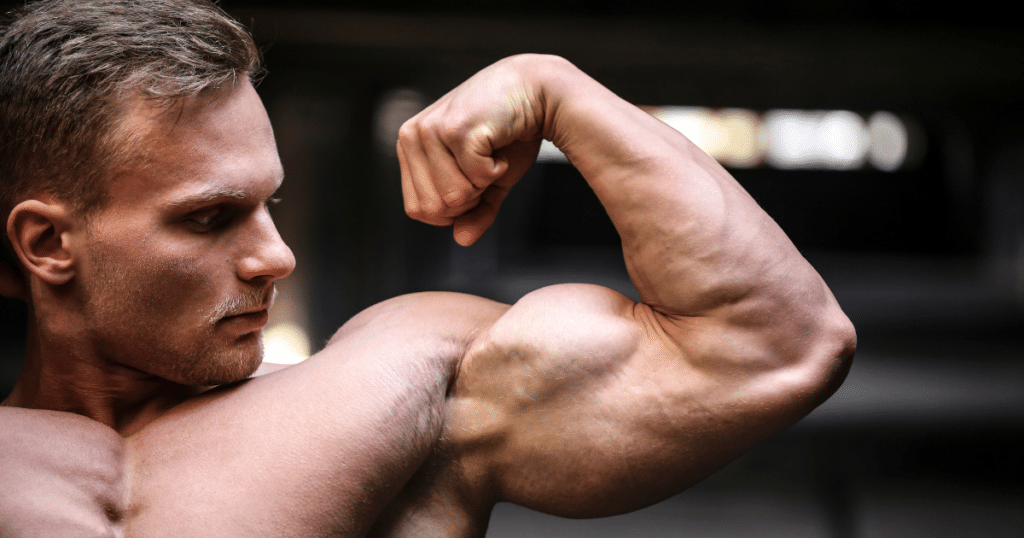
Investing in a few key pieces of equipment can open up a world of options for your at-home bicep workouts. Adjustable dumbbells and quality resistance bands are a fantastic starting point.
Related Article: Make Popeye Jealous — The Best Forearm Workouts with Dumbbells
Here are some excellent equipment options that I have personally used and recommend to my clients for their versatility and quality.
- Bodylastics Resistance Band Sets (Various Models Available): These are my go-to for travel. Many users praise their patented anti-snap design, which gives you peace of mind during intense workouts.
- Bodylastics Ultimate Resistance Bad Sets (Various Models Available)
- Bowflex SelectTech Adjustable Dumbbells: Known for their quick-turn dial system, these allow you to change weights in seconds, making them perfect for fast-paced workouts or drop sets.
- ProForm Adjustable Dumbbells
- PowerBlock Adjustable Dumbbells: These are incredibly durable and compact. Their unique blocky design makes them very stable when resting them on the floor.
- PowerBlock Elite Adjustable Dumbbells
- Cap Barbell Adjustable Dumbbells
- NordicTrack Adjustable Dumbbells
The resistance band options are perfect for when you travel. They are lightweight and can easily fit into a suitcase, allowing you to get a great bicep workout anywhere. I have found Bodylastics bands to be exceptionally high-quality and reliable over years of use.
Now, let’s get into the specific exercises for your at-home workouts for biceps. This list includes a mix of movements using dumbbells, resistance bands, and your own bodyweight.
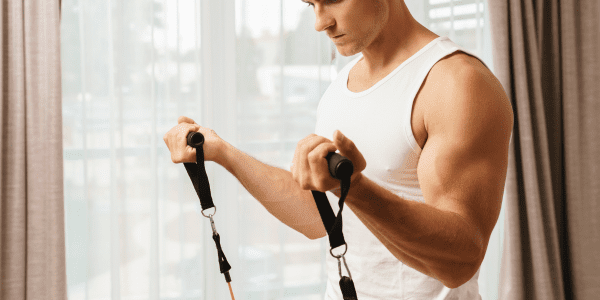
Below is a list of exercises that can be done at home to effectively target and work your biceps:
1. Dumbbell Curls
This is a classic for a reason. Stand holding a dumbbell in each hand with your palms facing forward. Curl one dumbbell toward your shoulder, keeping your upper arm stationary. For an extra peak contraction, focus on twisting your wrist outward (supination) at the top of the movement.
2. Hammer Curls
This variation uses a neutral grip where your palms face each other. Hammer curls are fantastic for targeting the brachialis and brachioradialis muscles, which adds significant thickness and width to your arms.
3. Resistance Band Curls
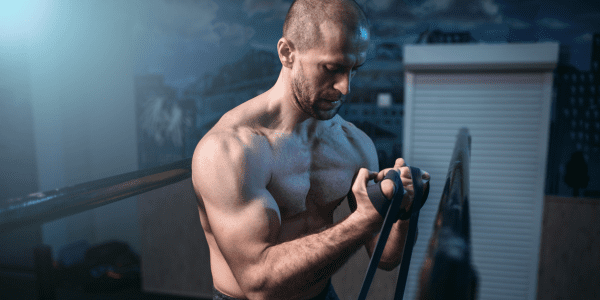
Stand on the middle of a resistance band and hold the handles with your palms facing forward. Curl up towards your shoulders. The great thing about bands is they provide “variable resistance,” meaning the tension increases as you stretch them, making the top of the curl the most challenging part.
4. Chin-Ups
Many think of this as a back exercise, but the close, underhand grip makes it a powerful bicep builder. If you have a pull-up bar, grab it with your palms facing you. Hang with your arms fully extended and pull your body up until your chin is over the bar, focusing on squeezing your biceps.
5. Inverted Rows
Lie on your back under a sturdy table or a bar set at waist height. Grab the edge with an overhand grip, keeping your body in a straight line. Pull your chest toward the table. While this is primarily a back exercise, your biceps work hard as secondary movers.
6. Isometric Bicep Holds
You can do this against a wall or with a dumbbell. Curl a weight to the halfway point (a 90-degree angle at your elbow) and simply hold it there for 20-30 seconds. This static contraction builds muscle endurance and can be surprisingly intense.
7. Towel Curls
This is a great option if you have no equipment. Stand on the middle of a towel with one foot and hold the ends in each hand. Create tension by pulling up as you curl. This is another form of isometric resistance that relies on your own strength.

8. Bodyweight Rows
This is similar to the inverted row. Find a sturdy table or bar. The more you walk your feet forward and create a horizontal body angle, the more of your bodyweight you will be lifting, making the exercise more challenging for your biceps and back.
9. Doorframe Rows
Stand in a sturdy doorframe and grab the sides at chest height. Lean back with your body straight and use your arms to pull your chest towards the doorframe. Focus on squeezing your biceps to initiate the pull.
10. Water Bottle Curls
If you are just starting out, you can use household items. Fill two large water bottles or milk jugs with water or sand to create makeshift weights. Perform standard bicep curls, focusing on a slow and controlled motion.
11. Backpack Curls
This is one of the best ways to apply progressive overload at home. Fill a backpack with books, cans, or other heavy items. You can easily adjust the weight. Hold the straps and perform curls, either with both hands or one at a time.
12. Resistance Band Hammer Curls
Just like the dumbbell version, stand on a resistance band but hold the handles with your palms facing each other in a neutral grip. This is a fantastic way to isolate the brachialis muscle using the variable resistance of the band.
13. L-Sit Chin-Ups
This is an advanced variation for those with a pull-up bar. As you perform a chin-up, hold your legs straight out in front of you in an “L” shape. This engages your core intensely and places a greater load on your biceps and lats, creating a powerful stimulus for growth.
14. Towel Grip Pull-Ups
Drape a towel over a pull-up bar and grip each end. This variation is incredibly challenging for your grip strength, which is often a limiting factor in arm development. It also intensely works your biceps and forearms.
With Some Creativity, At-Home Workouts for Biceps Can Be Effective
Building impressive biceps at home is not just possible, it is a practical goal. With creativity and an understanding of muscle-building principles, you can effectively develop your arms without a gym membership.
By using a mix of bicep curls, resistance band exercises, and clever bodyweight movements, you can create all the stimulus needed for muscle growth. Always focus on maintaining perfect form, increasing the challenge over time, and being consistent with your at-home workouts for biceps.
Remember that workouts are only part of the equation. Combine your training with proper nutrition and rest for the best results. Make sure you consume enough protein to support muscle growth and get at least 48 hours of recovery before training your arms again.
Building your ideal physique takes time and dedication, whether you are in a gym or your living room. Stay committed to your routine, and you can achieve significant gains and build biceps you can be proud of.
Embrace the convenience and challenge of at-home workouts for biceps, and get ready to transform your arms.
FAQs About At-Home Workouts for Biceps
How long does it take to see results from at-home bicep workouts?
With consistent training (2-3 times per week), proper nutrition, and adequate rest, you can start to see noticeable changes in muscle definition and strength within 4 to 8 weeks. Significant size gains may take several months of dedicated effort.
Can I build biceps without any equipment at all?
Yes, you can build biceps without traditional equipment by using bodyweight and household items. Exercises like chin-ups, doorframe rows, and backpack curls are highly effective. The key is to find creative ways to apply resistance and progressive overload.
What’s better for biceps: dumbbells or resistance bands?
Both are excellent tools. Dumbbells provide consistent resistance throughout the entire range of motion. Resistance bands offer variable resistance, which challenges your muscles differently, especially at the peak of the contraction. A 2023 study published in the *Journal of Human Kinetics* showed that both free weights and elastic bands can produce similar strength gains. The best approach is to incorporate both if possible.


*Disclosure: This article may contain affiliate links or ads, which means we earn a small commission at no extra cost to you if you make a purchase through these links. These commissions help support the operation and maintenance of our website, allowing us to continue producing free valuable content. Your support is genuinely appreciated, whether you choose to use our links or not. Thank you for being a part of our community and enjoying our content.
PLEASE CONSIDER SHARING THIS ON YOUR SOCIAL MEDIA TO HELP OTHERS LEARN MORE ABOUT THIS TOPIC.