
AHCC Supplements: Maximize Your Immune Function
AHCC supplements are on the rise and for good reason: they have some amazing science behind them. Interestingly enough, I learned about AHCC when I was looking into the benefits of mushroom extracts for a potential client.
That being said, here’s a sad dose of reality for you when it comes to some supplements out on the market: you know how some supplements sound promising until you compare the marketing with the dose used in real studies.
AHCC supplements fit that pattern; they are interesting, but they make the most sense when you look at the evidence and the practical details side by side.
AHCC, short for active hexose correlated compound, is a proprietary extract made from cultured shiitake mushroom mycelia.
The most useful human data points to immune signaling, T-cell activity, and a small but meaningful body of research on persistent hpv.
In this article, we’ll talk about whether or not you should take this supplement based on your goals. We’ll break down the use of AHCC supplements and what they can potentially do for you (like boost your immune system), proper use of AHCC supplementation, the duration of AHCC supplementation required, the therapeutic effects AHCC has the potential to provide, guidelines when taking the supplement, and more.
Key Takeaways
- AHCC is a proprietary mushroom extract (shiitake mushroom mycelia extract), not the same thing as a generic mushroom powder or a mixed medicinal mushroom blend.
- Small human studies suggest AHCC may support immune function by influencing dendritic cells, T cells, and natural killer cell activity, but the evidence base is still limited.
- In a 2022 phase II trial in women over 30 with persistent high-risk human papillomavirus, 14 of 22 participants in the AHCC arm tested negative after 6 months of 3 grams daily.
- The most common research protocol is AHCC 3 g once daily or the same total dose split before meals, usually for weeks or months, not just a few days.
- AHCC is generally well-tolerated, but it can cause mild digestive side effects and may interact with certain medications, so checking with a doctor is smart before you start.
What are AHCC Supplements?
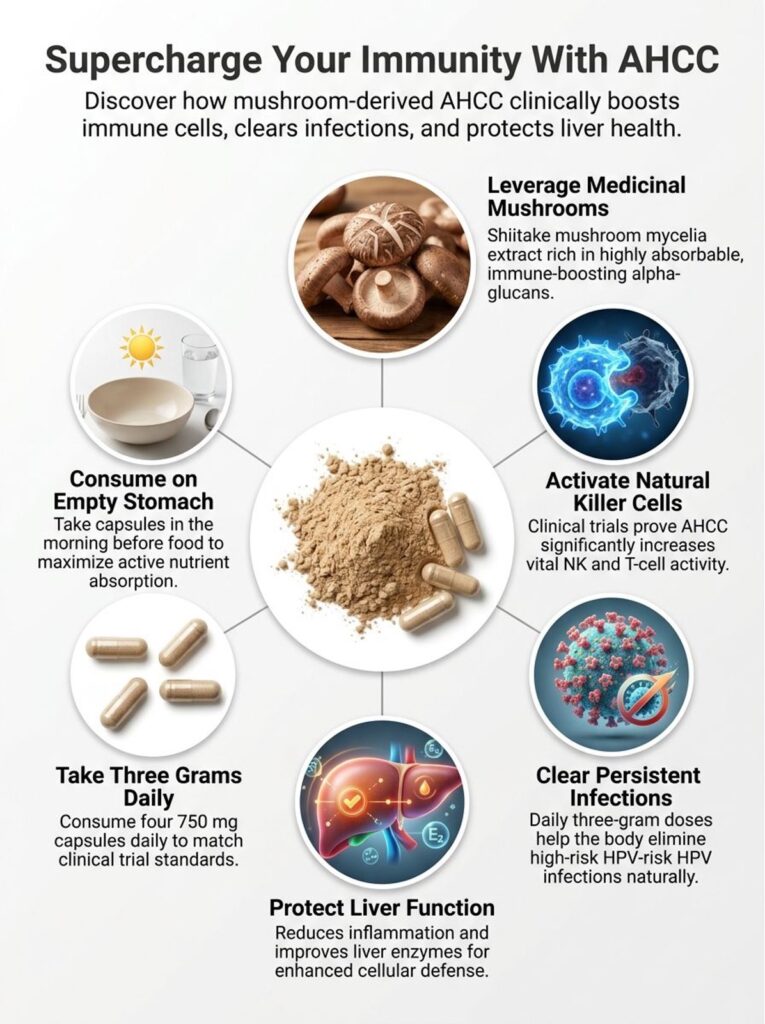
AHCC stands for Active Hexose Correlated Compound. It is a proprietary extract made from the cultured mycelia of shiitake mushroom (shiitake mushroom extract), and it is rich in low-molecular-weight alpha-glucans that researchers study for effects on the immune response.
That distinction matters with this mushroom extract supplement. AHCC is not the same as a standard mushroom fruiting body powder, and it is not just another vague “mushroom complex” on a label.
RELATED: 11 Foods That Boost Your Immune System
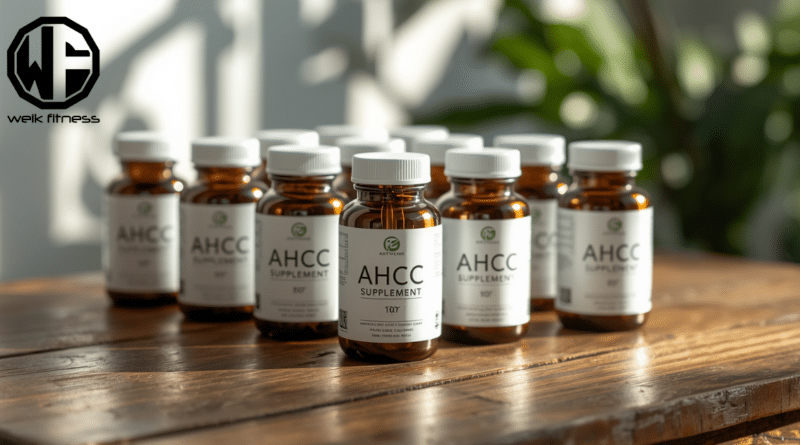
Because AHCC is a trademarked ingredient, product labels and capsule sizes matter more than most shoppers expect. The NIH Dietary Supplement Label Database lists US products in both 500 mg and 750 mg capsule formats, which is helpful because many people underestimate how many capsules it takes to match a clinical trial dose.
| Common capsule strength | Capsules needed to reach 3 grams | How long a 60-capsule bottle lasts |
| 500 mg | 6 capsules daily | 10 days |
| 750 mg | 4 capsules daily | 15 days |
If you are comparing products, look for a label that clearly names AHCC rather than relying on broad language like proprietary mushroom blend. That one check can save you from buying something that does not match the research at all.
How AHCC Supports Immune Function
The case for AHCC is not that it flips your immune system into overdrive. The better reading is that it may support specific immune pathways, especially dendritic cells, T-cell signaling, and natural killer cell activity, in small human studies.
How does AHCC boost Natural Killer (NK) cell activity?
If you want a quick refresher on natural killer cells, think of them as early-response immune cells that help your body react before the slower, more specialized parts of immunity fully ramp up. That is why AHCC keeps getting attention in research on viral defense and immune support.
The human signal here is promising, but still modest. In a 2022 UTHealth Houston phase II trial, women over 30 with persistent high-risk HPV infections lasting more than two years took 3 grams of AHCC daily for 6 months, and 14 of 22 in the AHCC arm tested negative by month six, with many responders keeping a durable response during follow-up.
Animal studies add mechanistic support. Researchers have also reported better resistance to influenza, West Nile virus, and bacterial infection in mice, which helps explain why AHCC may support natural immune defenses, even though animal data do not guarantee the same effect in healthy adults.
Promising immune markers are a reason to pay attention. They are not proof that every person who takes AHCC will get sick less often.
How does AHCC enhance T-cell function?
T cells are part of your adaptive immune system, the branch that learns, coordinates, and remembers. That makes them especially important if your goal is long-term immune function, not just a short burst of support.
RELATED: Lion’s Mane vs Cordyceps Supplements — Which Is Best?
In a 2008 double-blind, placebo-controlled trial, 21 healthy volunteers taking 3 grams per day for 4 weeks showed improved dendritic cell measures. That matters because dendritic cells help activate T cells and shape how the body responds to infection.
A 2010 human study then found stronger CD4+ and CD8+ T-cell production of interferon-gamma and TNF-alpha after at least 30 days of AHCC use, and some of that effect lingered for about 30 days after stopping. The practical takeaway is simple: taking AHCC supplements consistently for weeks makes more sense than using them for a day or two when you already feel run down.
- Think in weeks, not hours: AHCC is not a stimulant, so you should not expect an instant feeling.
- Consistency matters: daily use fits the human studies much better than occasional use.
- Match the goal to the protocol: if your goal is HPV support, the research used months of supplementation, not a short trial run.
How does AHCC modulate the immune response?
Mechanistically, AHCC seems to work upstream of symptoms.
A 2016 European Journal of Nutrition study linked AHCC-related immune signaling to TLR2 and TLR4 pathways in gut-associated immune tissue, which is why researchers describe it as an immunomodulator rather than a simple anti-inflammatory product.
There is also a small randomized study in 30 healthy adults showing a better antibody response to influenza B vaccination. That is useful context, but it should keep you grounded, not make you reckless.
CDC guidance still makes one point clear: supplements do not replace vaccination or screening. If persistent high-risk hpv is part of your reason for considering AHCC, keep up with cervical screening and ask your clinician about vaccination if you are still eligible.
- Use AHCC supplements as an adjunct, not as a replacement for standard care.
- Do not treat a supplement like a cure for hpv infections or other persistent viral issues.
- Keep the basics in place, including screening, recovery, and a conversation with your clinician when the issue is persistent.
Additional Health Benefits of AHCC Supplements
This is where many articles get too enthusiastic. AHCC may help in a few other areas, but the evidence is thinner and often comes from small, condition-specific studies rather than broad proof in healthy people.
How do AHCC supplements support liver function?
The best human liver data comes from a 2014 randomized, double-blind trial in 62 adults with mildly elevated liver enzymes linked to alcohol use. After 12 weeks, both the 1 gram and 3 gram AHCC groups showed a significantly better change in ALT than placebo, along with lower TNF-alpha and IL-1beta.
That tells you AHCC has biologic activity beyond theory. It does not mean nutritional AHCC supplements can replace treatment for hepatitis, cirrhosis, or other liver disease.
Older oncology data is also worth reading in context.
A 2002 prospective cohort linked AHCC use with better prognosis after hepatocellular carcinoma surgery, and a 2022 follow-up study looked at recurrence prevention after curative hepatectomy, but those findings apply to closely monitored cancer patients, not the average healthy person looking for everyday immune support.
The liver research is interesting because it shows measurable change in real people. It is still condition-specific, and it should not be stretched into a universal health claim.
What antioxidant properties does AHCC have?
AHCC supplements are often marketed for antioxidant support, and that claim has some mechanistic support. Lab and animal studies suggest lower oxidative stress and lower inflammatory signaling, which may help explain why AHCC keeps showing up in immune and liver research.
For everyday use, the honest takeaway is narrower. The human case for AHCC is stronger on immune markers and clear hpv research than on stand-alone antioxidant results you can feel from week to week.
A Phase I safety study using 9 grams per day for 14 days found mild, short-lived complaints such as nausea, diarrhea, bloating, headache, fatigue, and foot cramps in 20% of volunteers. That is one reason it makes sense to start carefully if you have a sensitive stomach.
- Do not buy it just because the label says mushroom; AHCC is a specific ingredient.
- Do not expect a fast boost in energy or recovery after a few doses.
- Stop and check in with a clinician if you notice persistent digestive upset, itching, or other side effects.
- Think of AHCC as a targeted supplement to help support immune function, not as a shortcut around the basics of health.
How to Use AHCC Supplements Effectively
The best plan is boring, and that is a good thing. Match the form, dose, and timing to the protocol you actually want to follow, then stay consistent long enough with AHCC supplements to judge it fairly.
What is the recommended dosage of AHCC?
For immune function and persistent HPV, the most repeated human research protocol is 3 grams of AHCC per day, usually for 6 months. That is the dose used in the phase II HPV trial and in earlier pilot work.
Lower doses have shown biologic activity in other settings. The 2014 liver enzyme trial used both 1 gram and 3 grams daily, which suggests there may be some flexibility depending on the goal.
| Research setting | Common daily dose | Typical duration |
| Healthy volunteer immune marker studies | 3 grams | 4 weeks |
| Persistent high-risk HPV studies | 3 grams | 6 months |
| Mild alcohol-related liver enzyme elevation | 1 or 3 grams | 12 weeks |
If you use capsules, do the math before you buy. A 60-capsule bottle lasts 15 days at 750 mg per capsule and only 10 days at 500 mg per capsule when you are trying to match a 3-gram protocol.
One more quality check matters: authentic AHCC is a trademarked ingredient. If a product only says mushroom extract or uses AHCC-like wording without clearly identifying the ingredient, you may be comparing a very different formula.
- Check your medications first, especially if you take cancer drugs, hormone therapy, or drugs metabolized through CYP2D6 pathways.
- Budget for the full course before you start, because the clinical trial style dose can use bottles quickly.
- Do not assume one capsule a day of AHCC supplements matches the evidence; it usually does not.
- Ask your clinician to help you personalize the dose if you have a medical condition or a history of side effects with supplements.
When is the best time to take AHCC supplements?
Most labels and clinical protocols place AHCC supplements before meals or on an empty stomach.
The NIH Dietary Supplement Label Database lists US products that suggest taking it before meals or without food, and one human liver study used twice-daily dosing 30 minutes before breakfast and dinner.
RELATED: PeakO2 — A Mushroom Supplement for Endurance?
If you are aiming for 3 grams daily, a split dose can be practical because it lines up with how some studies and labels handle capsule-heavy routines. That can also make the schedule easier to follow if four or six capsules at once feels like too much.
Memorial Sloan Kettering notes another important point here: AHCC supplements may interact with certain drugs, including some chemotherapy-support medications and aromatase inhibitors. If you are in active treatment, the best time to take AHCC supplements is after your oncology team says it fits your plan.
- Take it at the same time each day so you can judge it consistently.
- Give it at least 4 weeks before judging general immune system support supplement effects, and longer if you are following an HPV-focused protocol.
- Take it before meals if that matches your product label and your stomach tolerates it well.
- Get guidance before changing timing or dose if you start a new prescription medication.
Should You Try AHCC Supplements?
AHCC supplements have a real, though still limited, human research base. The strongest signals point to immune modulation, small studies on T-cell and dendritic-cell activity, and a phase II finding for persistent high-risk HPV.
If you decide to use AHCC supplements, choose a verified product, match the dose to the protocol you actually want to follow, and keep screening, vaccination, recovery, and clinician guidance at the center of your immune plan.
Do you need AHCC supplements? Check out our list below of recommended brands to consider:
FAQs
AHCC is an immune health supplement. The supplement is a proprietary extract, and the profile of AHCC shows it has the potential to boost immune cells and help the body fight infections. AHCC shows promise.
Yes, some data suggest that ahcc may decrease viral load and help clear hpv. A study demonstrated that AHCC was positive for hpv outcomes, and in one trial, fifty women with high-risk hpv were enrolled to test this effect.
AHCC, in a study, often produced better immune markers, and the study demonstrated that AHCC 3 reported improved responses in some people. These results suggest that ahcc may improve immune response, but more trials are needed to confirm how it helps respond to hpv.
The effects of AHCC are mild for most users, and few significant adverse side effects have been reported. Still, AHCC induces CYP2D6 in some cases, so it can change how drugs act; talk to your clinician before use.
Many trials used months of AHCC administration, and some data suggest AHCC supplementation is required beyond 3 months for benefit. Clinicians often recommend AHCC as an immune health supplement for those who want extra support, and some studies suggest AHCC also enhances immune markers.
References
- https://scholars.houstonmethodist.org/en/publications/ahccsupsup-supplementation-to-support-immune-function-to-clear-pe
- https://pmc.ncbi.nlm.nih.gov/articles/PMC9256908/
- https://pmc.ncbi.nlm.nih.gov/articles/PMC6942843/
- https://www.ebsco.com/research-starters/nutrition-and-dietetics/active-hexose-correlated-compound-ahcc-dietary-supplement


*Disclosure: This article may contain affiliate links or ads, which means we earn a small commission at no extra cost to you if you make a purchase through these links. These commissions help support the operation and maintenance of our website, allowing us to continue producing free valuable content. Your support is genuinely appreciated, whether you choose to use our links or not. Thank you for being a part of our community and enjoying our content.
PLEASE CONSIDER SHARING THIS ON YOUR SOCIAL MEDIA TO HELP OTHERS LEARN MORE ABOUT THIS TOPIC.