
Candela vs Lumens: What’s Best for Self-Defense?
Have you ever considered candela vs lumens for your self-defense light? It could be your EDC flashlight or even your weapon-mounted light (WML).
The unfortunate thing is that people shop for a self-defense light by chasing a big number on the box, then wonder why the beam and amount of light emitted still feels weak outside or in a backlit hallway.
That confusion usually comes down tolumens vs candela.
Lumens tell you the total amount of light a flashlight produces. Candela tells you how intense that light is in one direction, which is what gives you reach and a hard, attention-grabbing hot spot.
When you think of total lumens, you may think of the brightness of a light bulb. But we need to look deeper when it comes to the intensity of light for defensive purposes. It’s all about the beam of light or the focused beam of light coming out of a flashlight.
In this article, I’ll break down lumen output, candela value, lux, beam pattern and hot spot, then give you a practical way to choose for a weapon-mounted light or everyday carry.
Key Takeaways
- Lumens measure total light output. A 1500‑lumen flashlight can flood a room with light, yet still reach less distance than a lower-lumen light with better focus.
- Candela measures beam intensity and throw. Using the common FL1 test point of 0.25 lux, a 1,000,000‑candela beam calculates to about a 2,000‑meter beam distance in ideal conditions.
- Beam design can beat raw lumen count. Independent testing of the Weltool W4 Pro shows about 3,351 meters of throw with roughly 568 lumens, because it concentrates light into a very tight beam.
- For practical self-defense, balance matters. Aim for enough lumens to read corners and identify hands in a room, and enough candela to cut through streetlights, tinted glass, and other “photonic barriers” that wash out weak beams.
What Are Lumens and Candela?
If you want the short version, candela vs lumens describe different parts of the same problem.
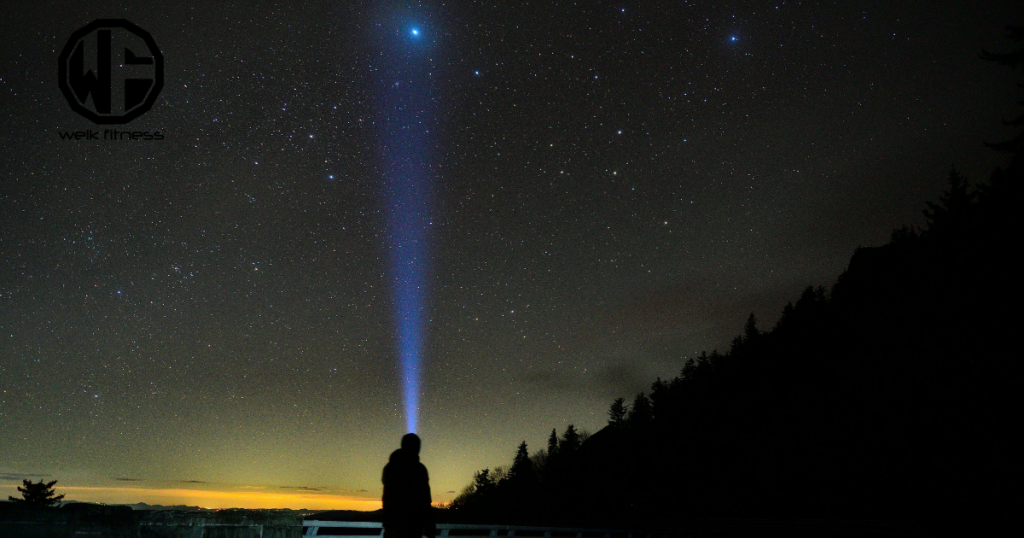
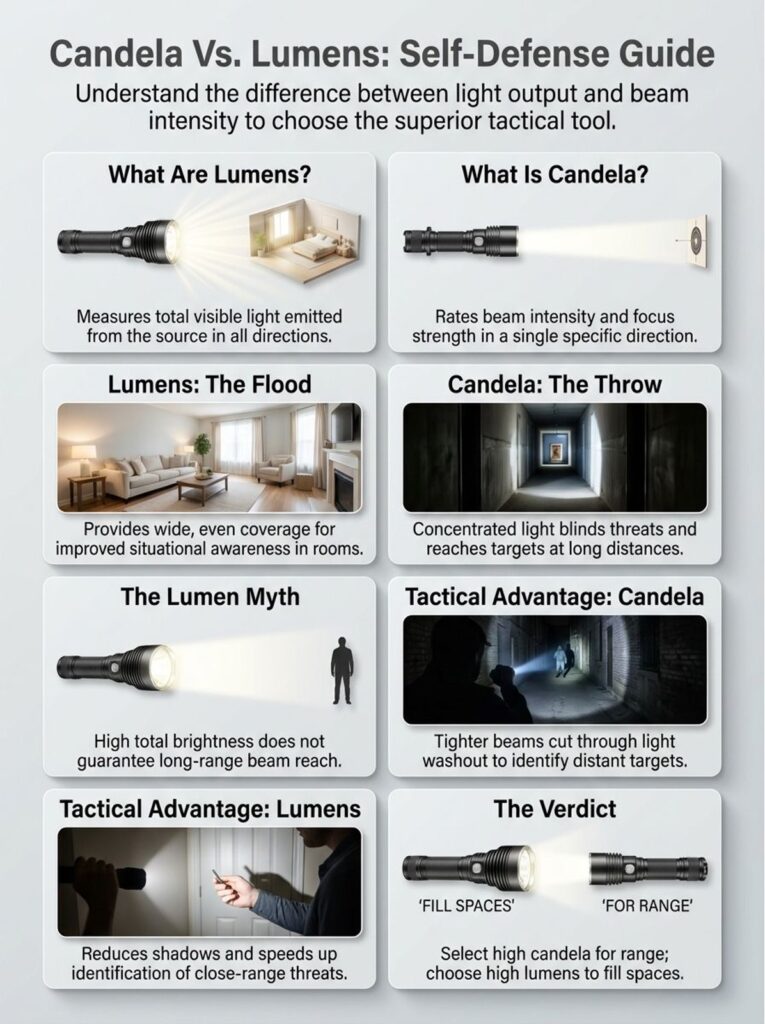
Lumens are the total light output coming out of a light source. Candela describes how much of that light is pushed into a specific direction as a concentrated beam.
For self-defense, that distinction matters because your eyes do not just “see lumens.” You see what lands on the target, and that depends on focus, distance, and beam pattern.
I’ve actually tried, tested, and reviewed a bunch of headlamps, flashlights, and WMLs over the years:
- Olight PL X
- Z-Bolt Blazer LEP & LED
- Modlite OKW
- Cloud Defensive MCH
- Streamlight ProTac HL-X
- Streamlight Super Siege
- Streamlight Microstream
What does lumens measure in a flashlight?
Lumens measure total brightness output from the flashlight, also called luminous flux (often shown as LM).
In real product testing, many manufacturers follow the ANSI/PLATO FL1 approach where the lumen rating is measured after the light has been on for 30 seconds, using an integrating sphere to capture the total light output.
Here’s the part people miss: a high-lumen “turbo” mode can be impressive for a moment, then step down as heat rises.
If you are choosing a light for carry or duty use, check whether the light can sustain its usable output, not just peak it.
- Use lumens to judge spill: how well the beam fills a room, hallway, or parking lot.
- Look for a realistic runtime: many lights quote runtime until output drops to 10% of the initial level (a common FL1 convention).
- Assume output changes affect the whole beam: when lumens drop over time, the candela of that same beam drops too, because it is the same light being focused.
- For indoor work: a lower “admin” mode is useful for searching, reading, and moving without blasting your own vision off white walls.
How is candela different from lumens?
Candela measures luminous intensity, basically how much light is concentrated into a specific direction (the hot spot).
Where lumens tell you total light output, candela tells you what that beam does at distance, and it tracks closely with reflector or optic design and the beam pattern.
A practical way to think about candela is beam distance math. In the FL1 method, beam distance is the distance where the beam measures 0.25 lux on a target, so distance in meters is roughly square root of (candela divided by 0.25).
Quick rule: if you want about double the throw, you need about four times the candela.
That is why two lights with similar lumens can look completely different outside. One may have a wide flood that dies fast, and the other may have a tight beam that keeps its punch.
Key Differences Between Candela vs Lumens
It’s common for people to get confused when it comes to candela vs lumens.
If you want one decision framework, use lumens to judge how much area you can light, and use candela to judge how far and how “hard” the beam hits.
Lux sits in the middle. Lux is what actually lands on the target, and lux changes with distance.
| Spec | What it tells you | Why you care in self-defense | Simple way to use it |
|---|---|---|---|
| Lumens | Total light output from the light source | Room and hallway awareness, reduced shadows, easier target identification up close | Pick enough lumens to light the space you expect to fight in |
| Candela | Peak intensity in a specific direction | Distance performance, better “stop and assess” light, better performance against backlight | Use candela rating (and beam distance, if listed) to estimate throw |
| Lux | Illuminance on a surface (light per area) | What your target actually receives, which is what your eyes respond to | Use a lux meter to compare lights at the same distance and hotspot aim |
Below is a great visual infographic explaining candela vs lumens.
When should you choose lumens for lighting?
Choose higher lumens when you need wide, even lighting that fills a room, a hallway, or a small yard.
For most home-defense layouts, enough high lumens helps you read corners and hands quickly, because the spill reduces shadow “dead zones.”
A concrete example: Streamlight lists the TLR-7 HL-X at up to 1,100 lumens and 23,000 candela, which is a useful balance for a compact, rail-mounted light when you want both spill and some reach. This WML would be ideal for something like my Sig Sauer P365 build.
- Indoors with light-colored walls: prioritize usable spill so you can see doorways and corners without sweeping the beam around like a laser pointer.
- Close-range ID: lumens help your eyes pick up detail faster, especially in cluttered rooms.
- Common pitfall: “all flood, low candela” beams can feel bright in the room, then fail outside or in a backlit doorway.
- Overall, brands like Streamlight and Surefire are great for lumen output. Some of their newer models have higher candela, but that’s not really what they are known for. For EDC tasks, it’s hard to beat the Steamlight Microstream. But I wouldn’t consider it ideal for self-defense use (unless used as a blunt object).
Why is candela better for focused, long-distance light?
Candela predicts long-range visibility because it measures peak beam intensity, not just total light output.
Using the FL1 0.25 lux definition, 1,000,000 candelas works out to roughly 2,000 meters of beam distance, which matches the “four times candela doubles distance” rule you see in real-world specs.
This is also why reflector size, optic design, and beam divergence matter so much. Two lights can have the same lumen output, yet the one with a tighter optic will place more of that light on the target.
The Weltool W4 Pro is the extreme example. Its very tight LEP-style beam has been measured around 3,351 meters of throw while producing roughly 568 lumens, so it reaches far but offers very little spill for room work.
Personally, the two candela monsters that I carry when I know I’m going to be outdoors at night are the Z-Bolt Blazer LEP (it’s like an actual laser beam) and the Cloud Defensive MCH.
How Do Candela and Lumens Affect Self-Defense?
In practical self-defense, your light is doing two jobs at once: it helps you identify what is happening, and it can disrupt a threat’s ability to act decisively for a moment. So, should we really be looking at it as candela vs lumens or should we look at having both?
I’m a fan of both (personally).
High candela gives you the “stop sign” hot spot. High lumens give you the spill that keeps you from missing the second person in the doorway.
For example, my Z-Bolt Blazer LEP has a hot spot that seems to go forever outdoors. I can see hundreds of yards away, but the hot spot is very concentrated. When I use something like my Streamlight ProTac HL-X, it can literally light up my backyard as if the sun were out.
The same can be said about the Streamlight TLR-1 HL that I carry on my Glocks in that it can light up a massive area since it pushes a ton of lumens (1,000 lumens), but also has a fairly decent hotspot thanks to 20,000 candela.
One safety point matters if you run a weapon-mounted light: Streamlight explicitly warns that they do not recommend carrying a light-equipped firearm without a proper holster that fully covers the trigger guard.
If you want to support a great brand of holsters that is veteran-owned, check out First Wave Holsters. I personally know the crew there, trust them, and support them whenever I can. They have both light-bearing and non-light-bearing holsters (IWB and OWB).
What tactical benefits come from high candela?
High candela gives you focused, long-range light that holds together at distance, even when the environment is fighting you.
That “fight” is what shooters often call photonic barriers: streetlights, headlights, bright porch lights, tinted windows, and even haze or smoke that can wash out a softer beam.
SureFire lists the X300T Turbo at 66,000 candela and 650 lumens with a 514-meter beam distance, which is a clean example of a pistol light built to push intensity downrange instead of flooding the whole room.
- Better downrange target ID: you can confirm what you are seeing sooner, especially outdoors.
- Cleaner beam through backlight: the hot spot stays defined instead of turning into glare.
- More useful throw from fewer lumens: candela is what makes a beam “reach,” not the raw amount of lumens.
- Tradeoff: extremely high candela beams can be so tight that you lose peripheral spill, which can slow room clearing if you do not manage the beam on purpose.
I have used a weapon-mounted flashlight on a low-light range, and the biggest practical advantage of higher candela was not “brightness.” It was how well the beam stayed useful when the target was farther away or backlit.
Personally, I have yet to find something that can compete with the Z-Bolt Blazer LEP handheld or WML. It’s absolutely bonkers what that light can do.
How are high lumens useful in practical self-defense?
High lumens shine in the distances that matter most indoors, across rooms, down hallways, and around furniture.
A wide, bright beam helps you process the whole scene faster, and it reduces the chance you miss movement outside the hot spot.
If you want a simple shopping shortcut, start by comparing a few common spec tiers. Streamlight lists the TLR-1 HL at 1,000 lumens and 20,000 candela, while newer high-candela variants like the TLR-1 HP are listed at 1,000 lumens and 65,000 candela.
| Example light (category) | Listed lumens | Listed candela | What that balance is good for |
|---|---|---|---|
| Streamlight TLR-1 HL (pistol WML) | 1,000 | 20,000 | Strong spill for rooms, workable reach for typical home distances |
| SureFire X300T Turbo (pistol WML) | 650 | 66,000 | Hard hot spot, better reach, and backlight performance |
| Modlite OKW head (handheld or rifle setup) | 680 | 69,000 | Intensity-forward beam when you want throw from a compact package |
| Cloud Defensive REIN 3.0 (rifle WML) | 1,250 | 100,000 | High output with high candela for distance and barrier-heavy environments |
A practical tip: choose a light that gives you at least two usable modes. Many shooters keep a lower mode for admin tasks and reserve the high mode for threat identification, which helps avoid blasting your own vision off reflective walls.
If you want examples, Modlite describes an “admin” mode on its OKW multi-mode heads that runs at about 15% output for extended runtime, which is exactly the kind of setting that is useful for searching without over-lighting the room.
You can also use a tactical flashlight with high lumens as your everyday carry option, then keep the weapon light tuned more toward candela if your environment demands reach.
Prepare Yourself By Understanding Light Output and Beam of Candela vs Lumens
For self-defense, stop treating candela vs lumens like a one-or-the-other choice.
High candela gives you a focused hot spot for downrange ID and better performance in backlit situations, and enough lumens gives you the spill you need to clear rooms and see escape routes.
Use lux and beam distance specs to sanity-check what a candela rating will do at your typical distances, then test your flashlight in low light so you know how the beam pattern behaves in your own spaces.
As a side note to close out this article, if you want to support our website and are in need of any tactical gear (or any product for that matter), anything you purchase using our Amazon link will provide us with a small commission. We don’t charge for our free content and our goal is to keep it that way. We don’t have a Patreon account to put things behind a paywall, nor do we sell pics of our feet on OnlyFans.
If you choose to use our link and make a purchase (at no additional cost to you), we greatly appreciate your support as it helps us continue to publish free content (like this article) on our website.
We have also partnered with CCW Safe. It’s the concealed carry coverage that I personally have for myself and my family in the event we need to defend our lives. I’ve trusted their coverage for over a decade and have no regrets. Feel free to use our CCW Safe link to sign up and get some coverage to protect yourself and your family.
Also if you have a product you would like us to check out and potentially review, please contact us and let’s discuss.
Candela vs Lumens FAQs
Lumens measure much total light a torch throws out, while candelas show how intense the beam is in one direction, they help in measuring light intensity. The term candela and lumens tell you different things about the light being emitted.
Pick candelas when you want to dazzle an attacker, candelas focus the beam and raise lux on a face. Pick lumens when you need to light a wide area.
A hallway needs about 50 lux, close ID needs 100 lux, and clear detail may need 500 lux; different lux levels matter. One lux is equal to one lumen per square meter, and moonlight is about 0.25 lux. Think lux vs lumens: lux and lumens measure different things.
Start by comparing candela vs lumens, and note how the light from the source spreads and how much light is being emitted from this apparatus. If the beam spreads wide, lumens stay high while candelas drop, if the beam is tight, candelas focus and the lux on target rises.
Yes, a high lumen flood can give lower candela and low blinding effect, so it may not make a brighter light at distance. You may have lower lumens in a tight spot, but more intense the light where you need it. If you need to dazzle, buy a light with high candela and enough lumens for the area.
The term candela is the unit for measuring light intensity of a point source, one candela gives one lux at one meter on a surface. Use that rule to estimate how much light covers a target, and to choose the proper light for self-defense.


*Disclosure: This article may contain affiliate links or ads, which means we earn a small commission at no extra cost to you if you make a purchase through these links. These commissions help support the operation and maintenance of our website, allowing us to continue producing free valuable content. Your support is genuinely appreciated, whether you choose to use our links or not. Thank you for being a part of our community and enjoying our content.
PLEASE CONSIDER SHARING THIS ON YOUR SOCIAL MEDIA TO HELP OTHERS LEARN MORE ABOUT THIS TOPIC.