
How To Conceal Carry While Driving
How to conceal carry while driving can be a challenge if you’ve never tried it before or are just playing around with the idea.
Carrying in your car is one of those things that sounds simple until you’re sitting behind the wheel, trying to figure out where the gun actually goes to allow for easy access, while trying not to have the pistol jam into your stomach or smash your twig and berries.
All in all, it’s not just about following the law when you carry a firearm in a vehicle.
It’s about making sure your CCW setup works when you’re buckled in, dealing with a steering wheel, and trying not to flag yourself or your passengers.
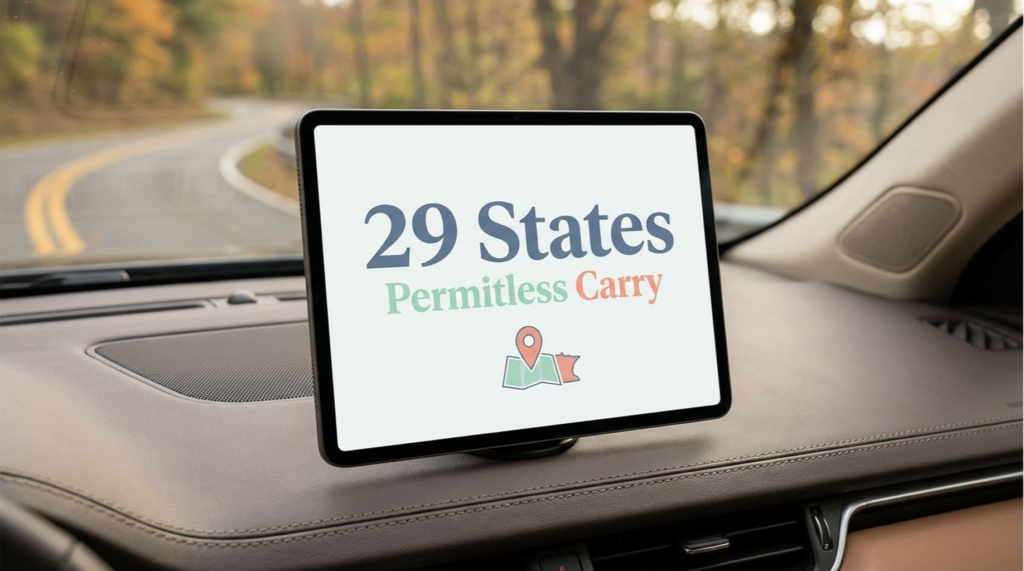
As of 2025, 29 states have enacted permitless carry laws, which sounds straightforward until you realize each one has different rules about vehicles, notification requirements, and where you can actually have a loaded gun.
According to a Johns Hopkins study analyzing data from 1980 to 2019, states that moved to less restrictive concealed carry laws saw firearm assault rates increase by an average of 9.5 percent in the first decade. This makes understanding your specific legal obligations and carrying safely in a vehicle more important than ever.
In this article, I’m going to walk through the legal framework (again, I’m not a lawyer and this is not legal advice, check and understand your local laws), the carry positions that actually work in a car, and the holster options that make sense when you’re seated.
Let’s break down what works and what doesn’t for when you decide to conceal carry while driving in your vehicle.
Key Takeaways
- As of 2025, 29 states allow permitless carry, but vehicle-specific restrictions still apply and vary widely by state, with many requiring valid permits for loaded firearms in the passenger area.
- Federal law under 18 U.S.C. § 926A covers the transport of unloaded firearms only, so it does not protect loaded vehicle carry, making state-by-state reciprocity checks mandatory via resources like USCCA reciprocity maps before crossing state lines.
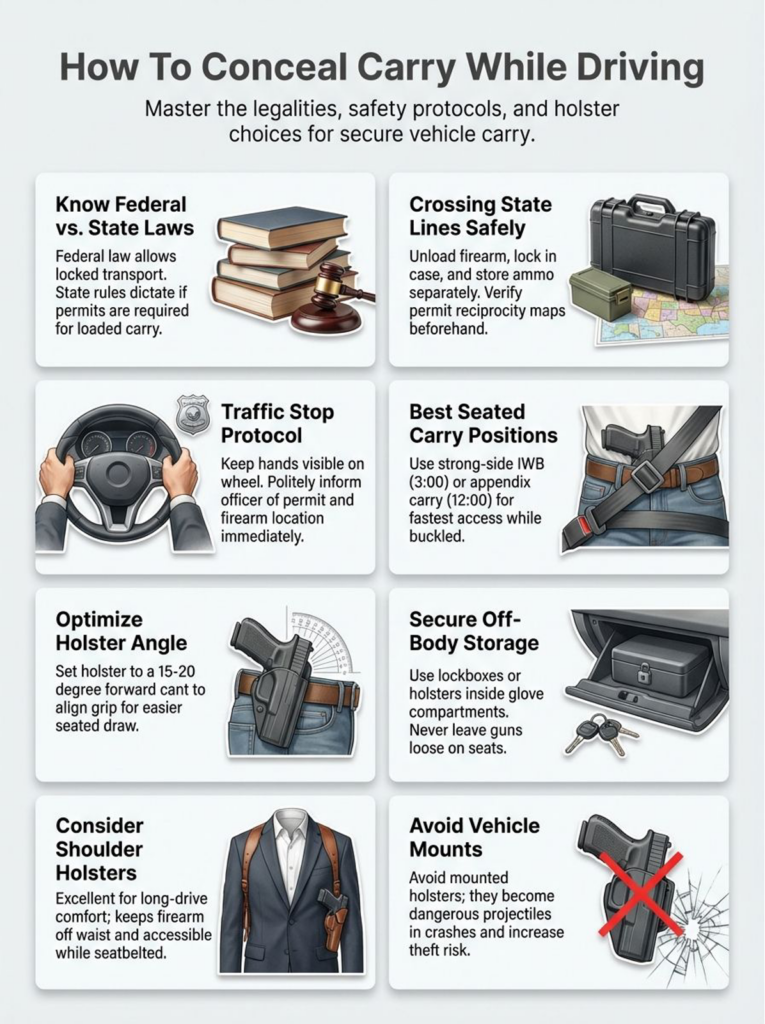
- Strong-side IWB carry at 3:00, or appendix carry at 12:00, both with 15-20 degree forward cant, provide the most reliable access while seated and buckled, according to multiple holster manufacturers.
- Duty to inform requirements exist in states like Alaska, Arkansas, Louisiana, Michigan, Nebraska, North Carolina, and Texas (when asked for ID), requiring immediate disclosure during traffic stops or facing penalties.
- Vehicle-mounted pistol holsters failed comprehensive 2025 crash testing by PHLster, with magnetic mounts and cupholder holsters ejecting firearms during airbag deployment at 200 mph, launching guns over 150 feet from vehicles and potentially creating serious injury risks.
Legal Requirements for Conceal Carry While Driving
The legal landscape for conceal carrying in a vehicle is more complicated than most people think. It’s deeper than simply having a valid concealed carry license or permit and having a holster mount in your vehicle or a good holster for car carry.
Federal law sets a baseline, but every state writes its own rules about what counts as legal vehicle carry and having a weapon in a vehicle.
Some states treat your car as an extension of your home, even though you’re physically inside the car. Others require specific permits or mandate that firearms be stored in particular ways when you have a concealed weapon in a car. Getting this wrong can turn a routine traffic stop into a criminal charge, so let’s start with what the law actually says at both the federal and state levels.
What Are the Differences Between Federal and State Laws on Conceal Carry While Driving?
Federal law, under 18 U.S.C. § 926A, covers the transport of an unloaded firearm between legal locations. That’s it. The gun must be locked up and inaccessible during transport.
This federal protection does not extend to loaded firearms kept for defensive use inside your vehicle, which is what most EDC carriers actually need. That puts vehicle carry squarely under state jurisdiction.
Each state writes its own rules when it comes to your ability to carry a loaded firearm in your vehicle.
As of 2025, 29 states have permitless carry laws on the books, where carrying concealed in a vehicle is legal. That number has grown significantly since 2023, when only 26 states allowed it.
Florida became the 26th state on July 1, 2023, and Louisiana, South Carolina, and Alabama followed in 2024. Texas allows permitless vehicle carry if you legally own the handgun. California, on the other hand, requires any firearm to be unloaded, locked in a case inside the trunk or glove box, and stored separately from ammunition (that’s because California is an anti-freedom state, in my opinion).
Out-of-state permits create another layer of complexity. You would think if you have a CCW permit in your own state, that the background check and everything else you need would apply to all states, right? That would make sense, no?
Well, that’s not how it works. Again, there are things that I bang my head against the wall for, and this is one of those things I simply don’t understand. How does crossing a state line change someone’s status of whether they are fit to carry a firearm concealed?
Unfortunately, not every state honors permits from other states.
North Carolina and Michigan recognize permits from any state, but many arrangements are unilateral rather than mutual agreements. If you cross state lines without checking reciprocity, you risk arrest even with a valid permit from your home state.
The Supreme Court decision in NYSRPA v. Bruen (2022) has pushed many jurisdictions to reevaluate permit requirements, but implementation varies widely, and changes happen faster at the state level than federal law ever moves.
How Do You Legally Cross State Lines With a Firearm That You Carry in a Car?
Crossing state lines with a firearm in your vehicle means navigating a patchwork of regulations that can shift the moment you cross a border. To put it bluntly, it sucks that not all states honor concealed carry permits and that it makes conceal carry while driving a pain.
So, if you plan to carry inside a vehicle, you need to understand and check your local laws where you’re traveling.
The Firearm Owners’ Protection Act (FOPA) provides limited protection for interstate transport. Under FOPA, you can move an unloaded firearm through restrictive states if it’s locked in a case and ammunition is stored separately.
States like New Jersey and New York enforce these requirements aggressively (because, like California, these states hate freedom). Police in these states get their rocks off arresting travelers for minor deviations, such as having a loaded magazine in the same case as the firearm, or stopping overnight in the state rather than passing directly through.
Reciprocity becomes the deciding factor for loaded carry during travel.
Before you leave, use tools like USCCA reciprocity maps to verify which states honor your concealed carry permit. Some permitless carry states allow non-residents to carry without a permit, such as Alabama, Mississippi, and Georgia, which simplifies cross-border travel within those regions.
But if you’re traveling from a permitless carry state to one that requires a permit, you’ll need a license from your home state to carry legally in the destination state, according to Johns Hopkins researchers analyzing these policies in 2025.
Plan your route carefully and know where you can legally stop.
Violations can range from misdemeanor citations to felony charges, depending on the state and circumstances. Some jurisdictions impose mandatory minimum sentences for firearms violations, making even a simple mistake costly.
When and How Should You Inform Law Enforcement During a Traffic Stop?
Traffic stops are one of the most common interactions between concealed carriers and law enforcement.
How you handle disclosure can determine whether the stop remains routine or escalates. Some states mandate immediate notification, while others require it only if asked. Getting this wrong can result in charges, even if you’re legally carrying.
Duty to Inform States
As of 2025, the following states require immediate disclosure during any law enforcement contact: Alaska, Arkansas, Louisiana, Michigan, Nebraska, North Carolina, and Washington D.C. Texas requires disclosure when asked for identification. Ohio removed its immediate duty to inform requirement in 2022 via SB 215, shifting to an “only when asked” standard.
Maine and North Dakota operate as hybrid systems. In Maine, permitless carriers must inform immediately, but permit holders are only required to show their permit if asked. North Dakota has the same split requirement.
Best Practices for Traffic Stops When You Conceal Carry While Driving
- Pull over safely, turn on interior lights if it’s dark, and keep both hands visible on the steering wheel as the officer approaches.
- In duty to inform states, disclose immediately as the officer reaches your window, using clear language like “Officer, I want to let you know I have my concealed carry permit and there is a firearm in my vehicle.”
- State where the firearm is located (e.g., “My handgun is in an IWB holster on my right hip” or “The pistol is secured in the center console”).
- Never reach for your permit, license, or firearm without explicit instruction from the officer; sudden movements near your holster increase risk for everyone involved.
- Follow every instruction from the officer promptly and calmly, even if the request seems unnecessary.
- Provide both your driver’s license and concealed carry permit together when asked for identification to eliminate confusion.
- Understand that officers may not immediately know your permit status since database systems don’t always sync instantly between agencies, making voluntary disclosure valuable for building trust.
- If stopped outside your home state, be aware that notification laws may differ, and many carriers choose to inform voluntarily, even in states without a legal requirement, as a courtesy.
- Remain calm and cooperative throughout the interaction, as compliance protects you legally and practically.
According to Kevin Michalowski, a sworn Wisconsin law enforcement officer with 17 years of experience and instructor at USCCA, the best thing an officer can hear is: “I am carrying a legally concealed firearm, and I have my permit with me. What would you like me to do?” This approach places control with the officer and demonstrates cooperation.
Choosing the Right Car Concealed Carry Method for Driving

Your everyday carry setup might work great when you’re walking around, but sitting in a car for hours changes everything. Conceal carry while driving isn’t exactly a pleasurable experience, but it doesn’t have to be unbearable.
That said, I would never recommend taking your firearm off your person to put it in a vehicle holster of any kind. Another reason to never take it off your person is in case you need to bail and ditch your vehicle quickly in an emergency, you’ll still have your firearm on you and have access to it immediately.
If you conceal carry while driving, you know the seatbelt cuts across your body, the steering wheel blocks certain draw angles, and the seat back presses against anything positioned behind your hip.
This is where most people’s carry plans fall apart.
The right method for driving isn’t just about comfort. It’s about maintaining fast access while you’re buckled in and seated, which rules out a lot of popular carry positions.
What Are the Best On-Body Carry Positions for Access of a Handgun While Seated?
Strong-side IWB carry at the 3:00 or 3:30 position works well for seated carry when you add a forward cant of 15 to 20 degrees. That said, I still don’t prefer that method.
If you prefer the 3:00 or 3:30 position, this setup places the firearm near your hip bone, allowing you to draw even when buckled in. However, some find it difficult when you have to fight the seatbelt, and the latch on the right side where you buckle may hinder your ability to get to and draw the firearm.
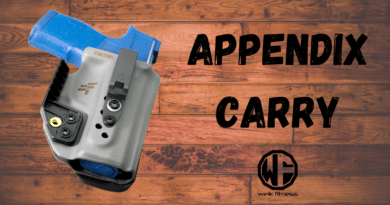
My preferred position will always be appendix carry (this goes for whether I’m going throughout my day or driving in a vehicle). Appendix carry at the 12:00 position or even 1:00 performs extremely well in vehicles. Many carriers find appendix draw faster and more intuitive when seated because the firearm sits directly in front of your body, clear of the seat back.
Seat height and vehicle type matter more than most people realize.
Trucks and SUVs provide extra space for on-body concealed carry compared to low-slung sports cars or compact sedans. If you drive a sedan with a reclined seating position, you’ll need to adjust your holster ride height higher to keep the grip accessible.
An upright seating posture improves reach significantly. Slouching or reclining pushes the firearm deeper into the seat and makes drawing awkward.
Body type affects what works.
Carriers with larger builds often find appendix carry uncomfortable during long drives due to pressure on the abdomen. Those with short torsos may prefer high-ride OWB holsters instead of deep-concealment IWB setups.
According to user experiences documented in 2025 forums, the cross-draw position at 10:00 to 11:00 works exceptionally well for drivers and office workers who spend extended time seated, as noted by Vedder Holsters research. That said, I’m personally not a fan and don’t recommend it.
But overall, consistency with your carry position is critical.
Your muscle memory during a high-stress event like a carjacking depends on your gun always being in the same spot. Switching carry positions between walking and driving increases the chance you’ll fumble when seconds count.
How Should You Adjust Carry Holster Placement for Quick Access When Conceal Carry While Driving?
Holster cant and ride height determine whether you can draw smoothly from a seated position or struggle with the seatbelt and steering wheel when you conceal carry while driving.
Small adjustments make a big difference. A forward cant of 15 to 20 degrees angles the grip toward your hand, allowing you to establish a firing grip without contorting your wrist. Vertical or negative cant holsters trap the firearm against the seat, slowing your draw and increasing the chance you’ll fumble under stress.
Move your holster slightly forward if your current position doesn’t allow easy access while seated.
Shifting from 4:00 to 3:30 or from 3:30 to appendix can clear the seat back and seatbelt.
Inside-the-waistband holsters with adjustable cant, like those from brands such as Vedder or Crossbreed, allow fine-tuning without buying a new holster.
Test your setup in your parked vehicle using dry-fire practice. The “One-Leg-Out” method, where you place one foot outside the vehicle, helps reduce seat interference during practice draws and reveals whether your holster position works under realistic conditions.
Avoid mounting holsters on seats or near the door.
Off-body carry inside the vehicle increases the risk of leaving your firearm in the car when you exit. It also slows down your response if you need to leave the vehicle quickly during an emergency.
Keep your holster on your body in a consistent location. Your draw stroke should be the same whether you’re standing in a parking lot or sitting buckled into your car.
Personally, I like to lift my shirt (or whatever I’m wearing) out from under the seat belt (and just lay it over the lap belt) so that I don’t have to worry about it snagging on the seat belt if I need to quickly get to my firearm. The lap belt simply goes across my pants/holster and still provides me with efficient and smooth access to my pistol if needed.
What Off-Body Holsters and Storage Solutions Are Safe and Practical?
Off-body carry in a vehicle requires more planning than on-body methods, but it can work if done correctly.
The key is ensuring your firearm remains secure, accessible, and protected by a trigger guard at all times. Many off-body setups fail because they prioritize convenience over safety, leaving firearms loose in compartments or relying on flimsy mounts that don’t hold up under stress.
Safe Storage Options
- Use a holster inside your glove box or center console that fully covers the trigger guard to prevent accidental discharge and keep the gun from shifting during sudden stops or impacts.
- Secure mobile gun safes, like those from brands such as Vaultek, with steel cables and foam linings, provide compliant storage. Bolt or lock them to anchors under your seat to prevent theft and keep firearms out of sight.
- Choose portable lockboxes that meet your state’s requirements for loaded or unloaded status, as rules change when you cross state lines.
- Avoid placing guns loose on seats, floors, or in door pockets, as any sudden stop or collision can send an unsecured firearm flying, creating serious safety risks for everyone in the vehicle.
- Ensure holsters fit tightly in designated compartments. Loose-fitting solutions allow the firearm to shift, which delays access during emergencies and increases the chance of damage.
While I’m not a fan of any vehicle-mounted holster, I understand you may feel it’s the only option you have. Vehicle-mounted holsters must cover the trigger guard and use strong mounting hardware.
The NRA published guidelines in 2021 emphasizing that any vehicle holster system should use screws, bolts, or high-strength adhesives for installation. Avoid soft zippered cases without inner holsters. These don’t secure the trigger area properly, raising legal concerns about responsible storage if law enforcement checks during a traffic stop.
Each off-body method has trade-offs between speed of access and secure transport. Again, I don’t like any option for off-body options.
Plan your conceal carry while driving method based on what your state allows and stay updated with changes in local concealed carry laws. Off-body storage works best as a temporary solution when you must disarm to enter prohibited areas, not as your primary carry method.
Having a gun in a vehicle safe is the only time I’d recommend not having your firearm on your person in your vehicle, due to legal reasons or needing to take your firearm off and leave it in a vehicle until you return and can put it back on your person.
Best Holster Options for Concealed Carry in a Vehicle
Finding a holster that works in a car comes down to three things: comfort during long drives, fast access while buckled in, and secure retention that doesn’t let the gun shift around.
Most holsters are designed for walking, not sitting. The ones that work in vehicles prioritize access over deep concealment and distribute weight in ways that don’t dig into your body after an hour behind the wheel.
Let’s break down which holster types actually perform when you’re seated.
Why Choose Inside-the-Waistband (IWB) Holsters for Concealed Carry in a Car?
IWB holsters conceal well even when you’re sitting in a car, reducing printing, and keeping your firearm out of sight from pedestrians or other drivers.
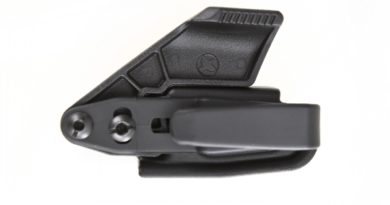
With an IWB setup, access remains fast if you position the holster correctly. The secure fit keeps your gun stable during sharp turns, sudden stops, and bumpy roads when conceal carry while driving. Popular IWB brands like Vedder Holsters, Crossbreed, and Alien Gear build Kydex and hybrid models specifically for vehicle use. The Alien Gear Cloak Tuck 3.5, for example, features adjustable ride height and cant settings, along with a breathable neoprene backer that reduces sweat during long commutes.
Slim IWB designs work under t-shirts or dress clothes without showing the outline of your firearm.
Soft backers, like those found in hybrid IWB holsters, reduce pinching and sweating during extended wear. These holsters accommodate both right- and left-handed carriers and adjust to different body types, providing flexibility for anyone who values consistent readiness.
According to multiple user reviews in 2025, hybrid IWB holsters like the Galco KingTuk remain comfortable even during 10-hour drives, with the leather backing molding to the body over time for a custom fit.
For seated carry, position your IWB holster at 3:00 with a forward cant of about 25 degrees.
This keeps the grip accessible and prevents the firearm from pressing uncomfortably into your back or side. Appendix carry at 12:00 to 1:00 also works well for drivers, as noted by carriers in defensive forums who report that this position provides the fastest access when buckled in.
Personally, I use a PHLster Pro or the PHLster Enigma when carrying my Sig Sauer P365 build (which I carry 90% of the time, otherwise it’s my G26 or G19). When I conceal carry while driving, I have my holster between 12:00 and 1:00. I also pull my shirt out from under the seatbelt so that I don’t have to fight it if I need to grab my firearm. I also ensure the seatbelt is across my holster and not my grip to ensure that I have easy access to purchase the firearm and get my full master grip immediately.
How Do On-Body Concealed Carry Shoulder Holsters Enhance Comfort While Seated?
Shoulder holsters distribute weight across your upper body instead of loading it onto your hips, waist, or lower back.
This makes them significantly more comfortable during long road trips or extended periods behind the wheel. A properly fitted shoulder rig sits high near your armpit, keeping the firearm accessible without interference from the seatbelt or steering wheel.
Many everyday carriers report less fatigue after hours of driving when using shoulder holsters compared to IWB or OWB setups.
Reaching for a shoulder holster while seated is fast and clear of the seatbelt.
The draw motion involves reaching across your chest, which is easier to execute when buckled in than reaching behind your hip or fighting a seatbelt for access to a strong-side holster. Galco manufactures popular shoulder systems like the Classic Lite Shoulder System and the Miami Classic, both of which use premium leather and adjustable harnesses for all-day wear.
According to a 2025 guide from Wright Leather Works, shoulder holsters are ideal for those who spend the entire day driving because they keep the firearm accessible without dealing with belt or seatbelt interference.
If you wear jackets or loose shirts, shoulder rigs easily conceal longer-barreled handguns without adding bulk at waist level.
The horizontal carry position keeps the firearm parallel to the ground, which conceals well under a suit jacket or coat. For drivers carrying without discomfort who need reliable access on the go, shoulder holsters provide a solid solution. The key is positioning the holster high enough near the armpit, as wearing it too low reduces comfort and makes the draw slower.
It should be noted that if you have passengers behind you, a shoulder holster is not ideal, as you’d be flagging them the entire time you conceal carry while driving.
Why Are Vehicle Mounted Pistol Holsters a Bad Idea?
As mentioned earlier, I’m not a fan of vehicle-mounted holsters. In fact, I hate everything about the idea. None of them is secure, and testing has proved this.
Vehicle-mounted pistol holsters create serious safety risks that most people don’t consider until it’s too late. In a crash, an improperly secured firearm becomes a projectile.
In 2025, PHLster Holsters conducted comprehensive crash testing on popular Amazon vehicle holsters, subjecting them to rough terrain, seatbelt pre-tensioner activation, airbag deployment, and vehicle rollover.
The results were clear: every single holster failed.
Magnetic mounts and cupholder holsters ejected firearms immediately when the vehicle hit bumps far less severe than a collision. During airbag deployment, a weighted training pistol was launched over 150 feet from the vehicle at approximately 200 mph, with magazines ejecting completely outside the car.
Mounting a holster near an airbag is particularly dangerous, which is why I recommend on-body when you conceal carry while driving.
The airbag deploys at 200 mph and can launch an unsecured firearm directly into your knee, torso, or face, causing severe injury or death. Even with tight mounting, the forces involved in a collision can break mounts or dislodge firearms, scattering them throughout the vehicle where you can’t access them during an emergency.
Theft from vehicles is another major concern.
Law enforcement reports show that firearms left in cars, especially those mounted in plain sight or easily accessible compartments, get stolen frequently. Vehicle-mounted guns are an invitation for theft when the car is left unattended.
Distractions while driving also raise the chance of accidental discharges. Poor muzzle control with vehicle mounts often means the weapon may point at yourself, passengers, or other drivers by mistake.
Car holsters slow down response time instead of improving it.
According to the 2025 PHLster testing, guns mounted in vehicles ended up under seats, on floorboards, and scattered throughout the interior after the simulated crash, making them inaccessible exactly when you’d need them most.
On-body carry, particularly appendix carry with a correctly worn seatbelt, poses no additional injury risk during seatbelt pre-tensioner deployment, as the force distributes across the hips and pelvis rather than the holster area.
Jon Hauptman of PHLster tested this out on himself. This shows that secure on-body carry is the safest and most effective method recommended by experts.
You Need to Know How to Carry a Concealed Firearm in a Car
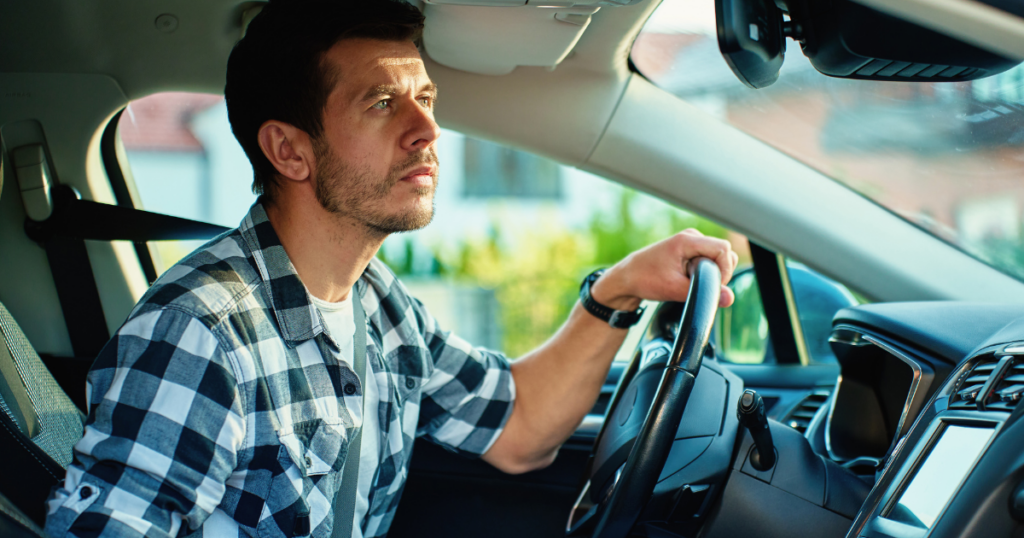
Conceal carry while driving takes discipline and a solid understanding of the legal requirements that shift every time you cross a state line.
Laws vary widely, so check reciprocity and duty to inform rules before you travel. The right holster or storage method keeps your firearm secure and within reach without compromising safety. Good habits behind the wheel protect you and everyone around you.
Stay alert, stay informed, and make every drive a responsible one.
As a side note to close out this article, if you want to support our website and are in need of any tactical gear (or any product for that matter), anything you purchase using our Amazon link will provide us with a small commission. We don’t charge for our free content and our goal is to keep it that way. We don’t have a Patreon account to put things behind a paywall, nor do we sell pics of our feet on OnlyFans.
If you choose to use our link and make a purchase (at no additional cost to you), we greatly appreciate your support as it helps us continue to publish free content (like this article) on our website.
We have also partnered with CCW Safe. It’s the concealed carry coverage that I personally have for myself and my family in the event we need to defend our lives. I’ve trusted their coverage for over a decade and have no regrets. Feel free to use our CCW Safe link to sign up and get some coverage to protect yourself and your family.
Also if you have a product you would like us to check out and potentially review, please contact us and let’s discuss.
How to Conceal Carry While Driving FAQs
You need a solid understanding of the legal requirements in your specific jurisdiction, especially since 29 states now allow permitless carry, while others like California still enforce strict permit mandates. Always verify if your destination honors your home state’s permit through a current reciprocity map before you start your engine.
It is recommended that you conceal your firearm on your person rather than putting it in a vehicle-mounted pistol holster. Tests have found that all of these devices fail, potentially causing injury to yourself or others in the vehicle if in an accident. If you must have your firearm in your vehicle, consider a lockable vehicle safe.
Under the Firearm Owners Protection Act (FOPA), you can legally transport a firearm through any state provided it is unloaded and locked in a trunk or container completely inaccessible from the passenger cabin (such as in a trunk).
States like North Carolina strictly require you to declare your firearm immediately upon contact, whereas Ohio recently removed this mandatory proactive notification requirement. To be safe, keep your hands visible on the steering wheel and calmly inform the officer of your status right away to establish trust.
References
- https://pmc.ncbi.nlm.nih.gov/articles/PMC10447713/
- https://www.usconcealedcarry.com/resources/traveling-with-firearms/private-vehicles/
- https://www.usconcealedcarry.com/blog/in-which-states-must-you-notify-an-officer-youre-carrying/
- https://aliengearholsters.com/blogs/news/how-to-conceal-while-driving
- https://policeandsecuritynews.com/imgs/archives/2024/mayjune24/mayjune03.pdf
- https://aliengearholsters.com/blogs/news/how-to-conceal-while-driving
- https://adaptivetactical.com/blogs/blog-1/the-top-7-benefits-of-using-an-inside-the-waistband-iwb-holster
- https://www.usconcealedcarry.com/blog/shoulder-holsters/
- https://www.thearmorylife.com/when-you-should-use-a-shoulder-holster/
- https://www.primerpeak.com/seven-reasons-why-car-holsters-are-bad/


*Disclosure: This article may contain affiliate links or ads, which means we earn a small commission at no extra cost to you if you make a purchase through these links. These commissions help support the operation and maintenance of our website, allowing us to continue producing free valuable content. Your support is genuinely appreciated, whether you choose to use our links or not. Thank you for being a part of our community and enjoying our content.
PLEASE CONSIDER SHARING THIS ON YOUR SOCIAL MEDIA TO HELP OTHERS LEARN MORE ABOUT THIS TOPIC.