

Casio F91W Watch: Worn By CIA, Special Forces & Terrorists?
You’ve probably seen the Casio F91W described as a “CIA watch,” a Special Forces beater, or even “the terrorist watch.” Those labels get repeated because they sound sharp, not because they’re always backed by actual evidence.
Here’s the practical truth: this digital watch is famous because it’s simple, cheap, and everywhere.
Let me be clear… This is not a watch I would have ever thought I’d have on my wrist.
I’m not afraid to say that I’m a watch snob. In my collection, you find brands like Rolex, Omega, Tudor, Tag Heuer, Longines, and many others. Collecting timepieces is one of the few expensive hobbies I have.
Heck, I even have the same Longines with the red strap that Kevin O’Leary (Mr. Wonderful) owns.
So, when I told my wife I was buying a watch for around $30, she thought I was absolutely nuts.
In this article, I’ll pin down the real specs collectors care about, explain what the Guantanamo-era records actually said (and what they did not say), and then walk you through a reliable counterfeit-check process.
Hopefully, by the end, you’ll learn something from this in-depth review of the Casio F-91W and want to buy one for your collection.
Key Takeaways
- The Casio F-91W is a long-running classic Casio with a quartz movement, three buttons, a daily alarm, an hourly chime, and a stopwatch. Casio describes the core design as essentially unchanged since its 1989 launch.
- Specs you can verify on the watch and caseback: module 593 marking, resin case, stainless steel caseback, LED backlight, and a CR2016 3-volt lithium button cell. Casio lists the case as 38.2 × 35.2 × 8.5 mm, weight at 21 g, accuracy at ±30 seconds per month, and battery life at about 7 years under standard assumptions.
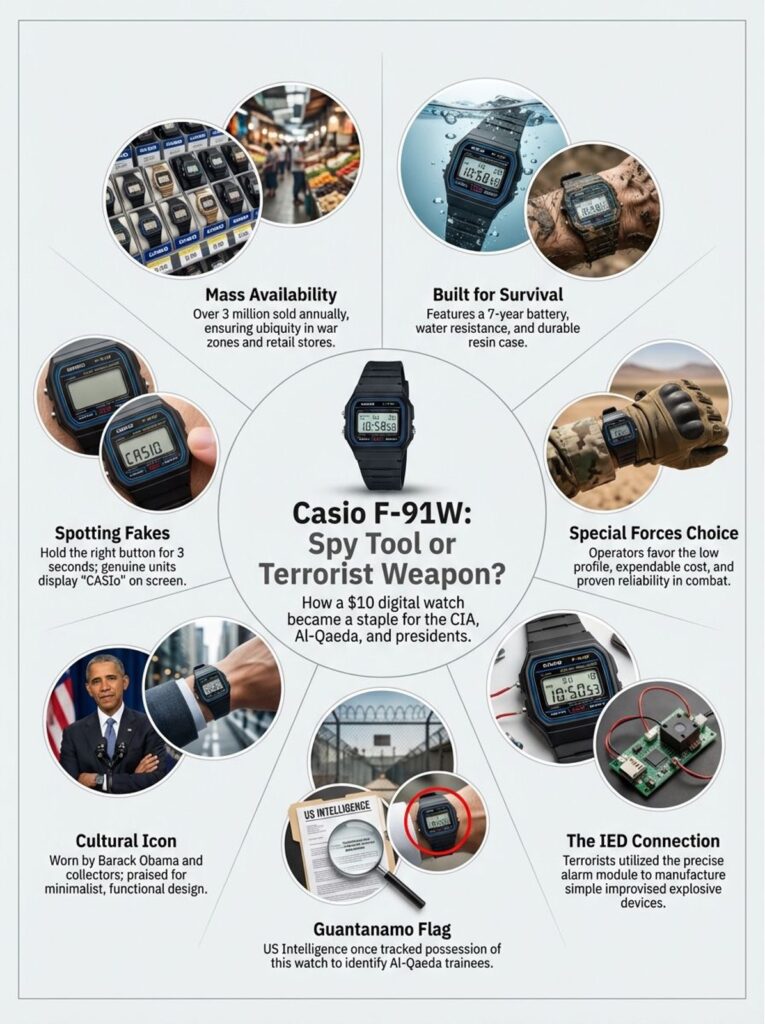
- The “terrorism” association is documented, but often oversimplified: in April 2011, reporting on Guantanamo training materials described the F91W as a “sign of al-Qaeda” style indicator used to guide interrogators.
- Casio watches have been used as bomb timers in real cases, but that’s about ease and availability, not a “magic” feature. For example, the Philippine Airlines Flight 434 bombing account describes a modified Casio Databank digital watch being used as a timer.
- A watch alone proves nothing. If you’re evaluating a “case of the Casio F-91W” tied to a story, treat it like any other provenance question: confirm authenticity first, then focus on documentation, chain of ownership, and context.
Key Features and Design of the Casio F91W
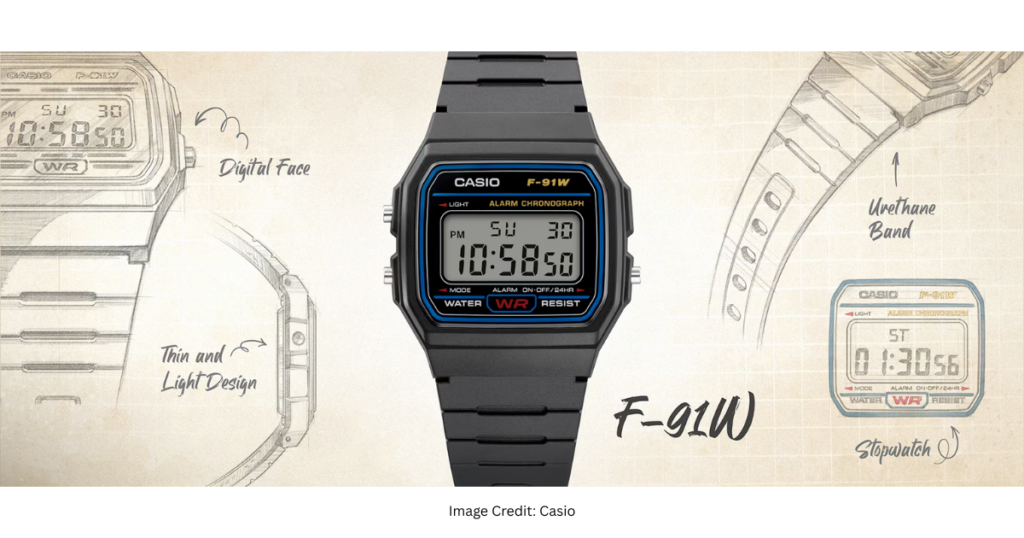
Collectors love the Casio F91W because it’s honest about what it is: a lightweight resin timepiece that nails the basics. You get clear timekeeping, a daily alarm, an hourly chime, a 1/100-second stopwatch, and an LED backlight in a case that disappears on the wrist.
If you’re building a watch collection that includes “real life” pieces, this one matters. It’s a baseline for what a no-nonsense digital watch can be.
| Feature | What you get | Why it matters to collectors |
|---|---|---|
| Case profile | 8.5 mm thick, 21 g | It wears flat, stacks well with cuffs, and feels like a true lightweight and durable daily tool watch. |
| Core functions | Alarm, hourly time signal, stopwatch, auto-calendar, 12/24-hour | It covers daily needs without the maintenance and fragility of automatic movements. |
| Power | CR2016 battery, rated around 7 years | It’s a “set it and forget it” digital watch, ideal as a first watch or backup watch. |
| Build | Resin case and resin strap, stainless steel caseback | Easy to wear, easy to swap a strap, and easy to authenticate by markings. |
What are the main features and specifications of the Casio F-91W variant?
Start with the basics: the Casio F-91W is a quartz digital watch built around module 593. You get a resin case, a stainless steel caseback, and that familiar three-button layout that makes it quick to use once your fingers learn it.
Casio’s own F-91W overview highlights the slim 8.5 mm profile and 21 g weight, plus the everyday feature set that made it a staple (alarm, stopwatch, calendar, LED light, and water resistance for day-to-day exposure).
- Timekeeping: 12/24-hour display, day of the week, date, and a simple PM indicator in 12-hour mode.
- Alarm mode: daily alarm and an hourly chime you can toggle on or off.
- Stopwatch: 1/100-second stopwatch with a capacity up to 59 minutes, 59.99 seconds.
- Backlight: an LED “microlight” style backlight (often described as a green-tinted LED on current listings).
If you want a quick functional check before you buy, run these two “owner checks” in the store:
- Button feel: the three buttons should feel consistent, with no grinding or mushy travel.
- Mode cycling: timekeeping, alarm, and stopwatch should all display cleanly with no missing segments.
How durable and well-designed is the Casio F91W classic quartz?
The design is durable in the way collectors usually mean it: it survives daily wear, and it’s cheap enough that you’ll actually wear this watch instead of babying it. The resin case takes knocks well, and the stainless steel caseback helps the structure feel more “real watch” than toy.
On paper, the accuracy spec is straightforward: ±30 seconds per month for standard quartz timekeeping. In practice, many owners see better results, but the rating tells you what Casio is willing to stand behind.
Here are the real-world pitfalls that affect longevity more than the resin itself:
- Water resistance is limited by design. Several retailer spec sheets explicitly frame the Casio F-91W’s water resistance as suitable for minor splashing, not swimming. Treat it like “rain and handwashing,” not “pool watch,” and avoid pressing buttons while it’s wet.
- Battery swaps are simple, but be careful. If you replace the CR2016, keep the caseback screws snug and even, and make sure the gasket sits flat so you don’t lose what water resistance you have.
- Strap upgrades are part of the fun. The lug width is 18 mm, while the stock resin strap flares wider at the case for that integrated look. An 18 mm NATO works, but many collectors use adapters to run a wider strap for better visual balance.
- As someone who regularly has an expensive watch on his wrist, it’s somewhat freeing to have a watch on my wrist that I really don’t care what happens to it. Also, it’s fun to see friends and family ask what I’m wearing since they’re used to seeing me with analog watches.
Military and Intelligence Use of the Lightweight Casio F-91W
This is where the internet tends to blur three very different ideas: “people in the military buy it,” “it appears in intelligence-adjacent stories,” and “it was used as an investigative indicator.” Those are not the same claim, and mixing them is how myths take hold.
RELATED: Field Watches 101 — A Guide to Durable Timekeeping Outdoors
Here’s the clean way to think about it as a collector: the Casio F-91W is credible as a low-profile, common, field-friendly watch, and it’s also documented as a watch model referenced in Guantanamo-era materials. The first point is about practicality. The second point is about a specific moment in time and a specific investigative mindset.
Why does the CIA use the Casio F91W?
You’ll see “worn by CIA” repeated a lot, but you should treat it as a vibe claim unless someone can point to a verifiable procurement record or a declassified gear list. Public proof is thin, and intelligence work does not advertise its shopping receipts.
What you can verify is why a watch like this fits intelligence tradecraft in general: it’s cheap, replaceable, easy to read, and it doesn’t broadcast anything. It also runs on a single lithium metal battery, so you don’t deal with charging or a cable that becomes part of your routine.
- Low signature: no pairing, no notifications, no connectivity footprint.
- Easy time discipline: the display always shows seconds, so you can sync quickly and keep a clean reference.
- Disposable economics: if you crack it, you replace it, and you move on.
A pro-tip I give collectors who actually plan to wear this watch hard: turn off the hourly chime. Honestly, it’s annoying and a liability anywhere you care about noise discipline.
How have Special Forces adopted the Casio F91W?
For Special Forces, the most believable part of the story is also the least exciting: lots of people in harsh environments choose simple kit. A resin digital watch with an alarm mode, a timer mindset, and a long battery life is useful in the field, even if it’s not “issued.”
If you want a collector-friendly way to frame the Casio F-91W inside a broader tool-watch lineup, compare it to two common alternatives:
| Watch type | Why collectors pick it | Trade-offs |
|---|---|---|
| Casio F-91W (module 593) | Featherweight comfort, classic quartz reliability, iconic retro watch look, and cheap enough to truly wear this watch anywhere | Limited water resistance and a modest backlight |
| G-Shock Square (DW-5600 family) | Big upgrade in shock resistance and water resistance expectations, plus a deeper feature set for timing | Thicker on the wrist, more “noticeable” visually |
| Seiko 5 Sports (4R36 automatic) | Mechanical charm for a watch collection, with day/date and solid specs; Seiko’s U.S. listings commonly cite about a 41-hour power reserve | Automatic movements need more care and can’t match quartz’s grab-and-go convenience |
Controversies Linking the Casio F-91W to Terrorism

The Casio F-91W controversy is real, but it’s also easy to misread. The watch got pulled into counterterrorism narratives because it’s common, functional, and easy to adapt as a timer, not because owning one is meaningful by itself.
In April 2011, reporting on leaked Guantanamo materials described the Casio F-91W as “the sign of al-Qaeda” in guidance used to assess detainees.
RELATED: The History of Military Camo Patterns
Those materials did not turn a watch into proof. They turned a watch into a prompt for more questioning, which is an important distinction if you care about facts and not headlines.
How is the Casio F91W associated with terrorist groups?
The cleanest documented link is Guantanamo-era paperwork culture.
Reporting on the detainee assessments noted that Casio watches appeared repeatedly, and one public radio report in 2011 described the Casio F91W being mentioned nearly 150 times across the file set.
What that means for your understanding, and for collector conversation, is this:
- Documented: the Casio F91W (and similar Casio watches) shows up in investigative narratives and threat-indicator guidance from that period.
- Not documented: a reliable rule that the watch identifies a group member, or that the Casio F91W is a unique “terror tool” compared to other everyday timers.
In what ways is the Casio F91W used in improvised devices?
When a digital watch appears in bomb-making discussions, it’s usually because it provides a stable time base, a simple alarm, and electronics that can be repurposed.
The point is accessibility. A device that’s sold everywhere is easier to replace, easier to practice on, and easier to hide in plain sight.
Two well-cited examples help collectors separate myth from mechanism:
- 1994: the Philippine Airlines Flight 434 account describes Ramzi Ahmed Yousef using a modified Casio Databank digital watch as a timer while assembling the bomb.
- Mid-1990s reporting: bomb investigators and journalists described how commonly available Casio digital watches could be reconfigured into timing components, emphasizing that there was nothing exclusive about the technology.
This is also why the most responsible takeaway stays boring: the watch matters far less than the surrounding evidence.
If you’re evaluating a story tied to Abdul Hakim Murad, Ramzi Ahmed Yousef, or Guantanamo detainees, don’t let the watch do the thinking for you.
The Casio F91W as a Cultural Icon
Strip away the headlines, and you’re left with the real reason the Casio F-91W became iconic: it’s one of the most “enough” watches ever made. It does timekeeping, alarm, and chronograph duties, and it does them with almost no ownership friction.
That’s why it sits in serious collections right next to G-Shock, Seiko, and even the occasional Rolex or Omega. It’s a reference point.
Why is the Casio F91W seen as a symbol of minimalism and functionality?
Casio positions the F91W as an enduring standard with a design lineage that traces back to 1989. That matters to collectors because it gives you a stable object to collect around: the basics stay familiar even as variants and trims come and go.
If you want the collector’s “why,” it usually comes down to these four points:
- Comfort: slim case, light weight, and a resin strap that’s easy to live with.
- Clarity: clean dial layout with day of the week and seconds always visible.
- Independence: no apps, no charging, no updates, no pairing.
- Value: it’s often priced so you can actually wear it daily without anxiety, even if you also own a best watch in a higher tier.
If you’re buying for the first time, treat “too cheap to be true” pricing as a counterfeit risk, not a deal.
What contributes to the Casio F91W’s global appeal and community recognition?
The community element is bigger than people expect. The Casio F-91W is endlessly modded: resin strap swaps, NATO setups, display comparisons, and debates over tiny print differences across production runs.
IEEE Spectrum noted a commonly cited estimate of roughly 3 million units produced per year and used that figure to sketch a ballpark of tens of millions shipped over decades. Even if you don’t care about the exact number, the implication is clear: a huge installed base creates a huge community.
To put things into perspective, one million Rolex watches are sold every year. Just the Casio F91W alone sells three million annually.
If you want to participate without getting burned, focus on verifiable details collectors share:
- Know the fit: the lug width is 18 mm, but the stock strap’s flare makes some third-party straps look skinny unless you use adapters.
- Know the variants: Casio’s modern lineup includes classic black models, gold colored and gold trim variants, translucent color runs, and occasional collaborations.
- Know your baseline: start with one clean, verified, authentic example. It becomes your reference when you’re judging photos later.
Identifying Fake Casio F91W Watches
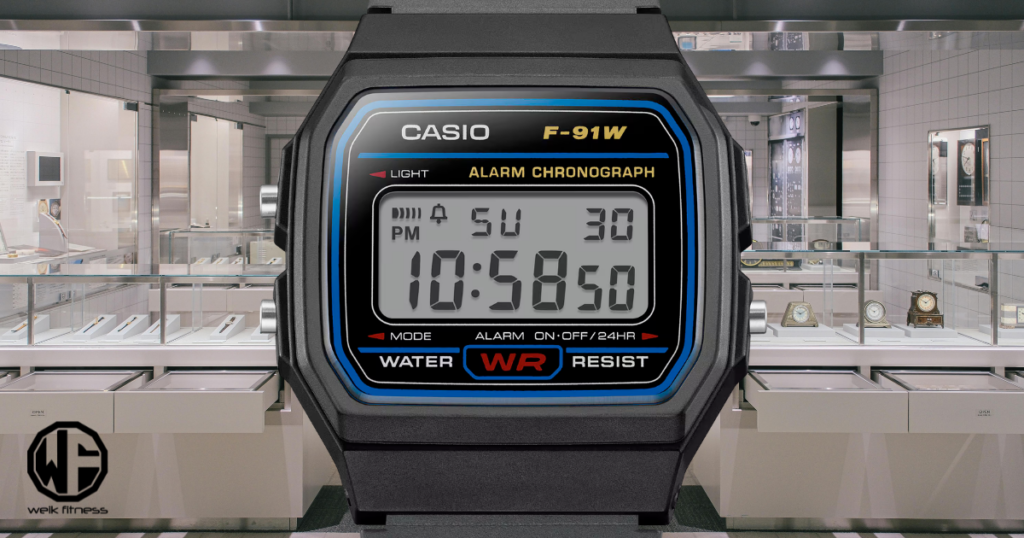
The Casio F-91W is one of those rare watches that gets counterfeited even though the real one is inexpensive. That means you need a repeatable process, not a single “magic” test.
Your goal is simple: confirm the watch matches known module 593 behavior and known finishing quality, and confirm the seller and packaging make sense for the U.S. market.
How can you spot counterfeit Casio F91W watches?
Start with what you can measure and observe quickly. Casio lists the genuine watch at 21 g and a case thickness of 8.5 mm, so a cheap kitchen scale and a basic caliper can catch bad fakes fast.
| Check | What you want to see on a genuine Casio F-91W | Common counterfeit tells |
|---|---|---|
| Caseback and module markings | Clean stamping, stainless steel caseback, and module 593 markings typical of the model | Soft or messy stamping, odd fonts, wrong model text, inconsistent spacing |
| Display quality | Even segment fill, good contrast, stable viewing angle | Washed-out LCD, uneven segments, odd tint, missing crispness |
| Button behavior | Consistent click feel and predictable mode changes | Mushy feel, weird mode cycling, inconsistent responsiveness |
| “CASIo” screen test | Often displays “CASIo” when you hold the lower right button in timekeeping mode | Some fakes now mimic this, so a pass is not proof |
| Weight and dimensions | About 21 g, slim profile | Noticeably off-spec weight or bulk, or sloppy fit between case parts |
Use this step-by-step flow so you don’t overtrust one trick:
- Run the quick screen checks: try the “CASIo” display test and the all-segments LCD test (pressing multiple buttons at once). Treat results as signals, not a verdict.
- Inspect printing alignment: on many fakes, “CASIO,” “F-91W,” and the “ALARM CHRONOGRAPH” text sit slightly off or use the wrong weight of font.
- Compare the beep and backlight: collectors often notice fakes have harsher, higher-pitched beeps and weaker illumination.
- Check seller logic: if the price is far below normal U.S. retail ranges or the return policy is evasive, assume higher risk.
- Timekeeping sanity check: over a month, a genuine watch should stay within its rated ±30 seconds per month. If it drifts by minutes, treat that as a serious red flag.
One last collector note: production details change across years and factories. Don’t convict a watch over a single detail like a missing mark. Stack multiple signals, then decide.
Should You Add the Casio F91W to Your Watch Collection?
You don’t have to have a Casio collection to appreciate this watch. Sure, it’s no Apple Watch with a ton of features, but that’s ok. Sometimes, simplicity is best, and this is one of the Casios that’s truly timeless.
The Casio F-91W earned its place because it’s an iconic watch that delivers clean timekeeping, a useful alarm, and a genuinely wearable lightweight design.
Yes, it shows up in Guantanamo-era reporting and in discussions of improvised devices, but those stories are about context and investigative assumptions, not about the watch “meaning” anything on its own.
RELATED: Garmin Instinct Tactical — A Tacti-Cool or Functional Watch?
Whether you’re a collector or not, get the watch… you’ll love it.
Click here to grab one at a low price. It’s also where I purchased mine.
As a side note to close out this article, if you want to support our website and are in need of any tactical gear (or any product for that matter), anything you purchase using our Amazon link will provide us with a small commission. We don’t charge for our free content and our goal is to keep it that way. We don’t have a Patreon account to put things behind a paywall, nor do we sell pics of our feet on OnlyFans.
If you choose to use our link and make a purchase (at no additional cost to you), we greatly appreciate your support as it helps us continue to publish free content (like this article) on our website.
We have also partnered with CCW Safe. It’s the concealed carry coverage that I personally have for myself and my family in the event we need to defend our lives. I’ve trusted their coverage for over a decade and have no regrets. Feel free to use our CCW Safe link to sign up and get some coverage to protect yourself and your family.
Also if you have a product you would like us to check out and potentially review, please contact us and let’s discuss.
FAQs
The Casio F91W is a simple, cheap digital watch that many people wear for its long battery life and clear display. The watch drew attention after reports linked it to CIA files and use by some militants, but those mentions do not make it rare.
Yes, reports show the CIA and other intelligence agencies noted the watch, and some Special Forces members used it for basic timekeeping. Extremists also used it in some cases, but usage came from practicality, not training.
No, millions of people wear the watch for work, school, and sport. A watch alone does not show intent or membership in a violent group.
No, the watch is fine for daily use, it is durable and low cost. If you travel to a tense area, stay aware that authorities may ask questions, but normal wear usually causes no trouble.
References
- https://en.wikipedia.org/wiki/Casio_F-91W
- https://www.watchesofespionage.com/blogs/woe-dispatch/casio-f-91w-the-preferred-watch-of-terrorists
- https://www.bbc.com/news/magazine-13194733
- https://www.youtube.com/watch?v=lp1MKsCbArY


*Disclosure: This article may contain affiliate links or ads, which means we earn a small commission at no extra cost to you if you make a purchase through these links. These commissions help support the operation and maintenance of our website, allowing us to continue producing free valuable content. Your support is genuinely appreciated, whether you choose to use our links or not. Thank you for being a part of our community and enjoying our content.
PLEASE CONSIDER SHARING THIS ON YOUR SOCIAL MEDIA TO HELP OTHERS LEARN MORE ABOUT THIS TOPIC.