Best Baseball Training Balls
If you haven’t looked into baseball training balls, you’re missing out. Training baseballs save so much of my time that I had to dedicate an entire article to just this topic.
If you’re a baseball coach or help your kids practice at home, you know all too well that most of your time is spent running down and chasing after baseballs that your kids hit. And to be real, it’s tiresome. I’d rather spend my time helping my kids than chasing down balls that seem to be hit into the next county.
Baseball training balls matter more than most players, parents, and coaches think.
The right training ball changes the whole drill. A limited-flight ball keeps backyard and cage work tight, a plastic ball lets you stack safe reps, and a weighted baseball belongs in a measured throwing plan, not a random warmup bucket.
In this article, I’m going to break down the ball types that actually help, the features that make them worth buying, and the best picks for hitting, pitching, and fielding.
RELATED: Marucci CATX2 BBCOR Baseball Bat Review
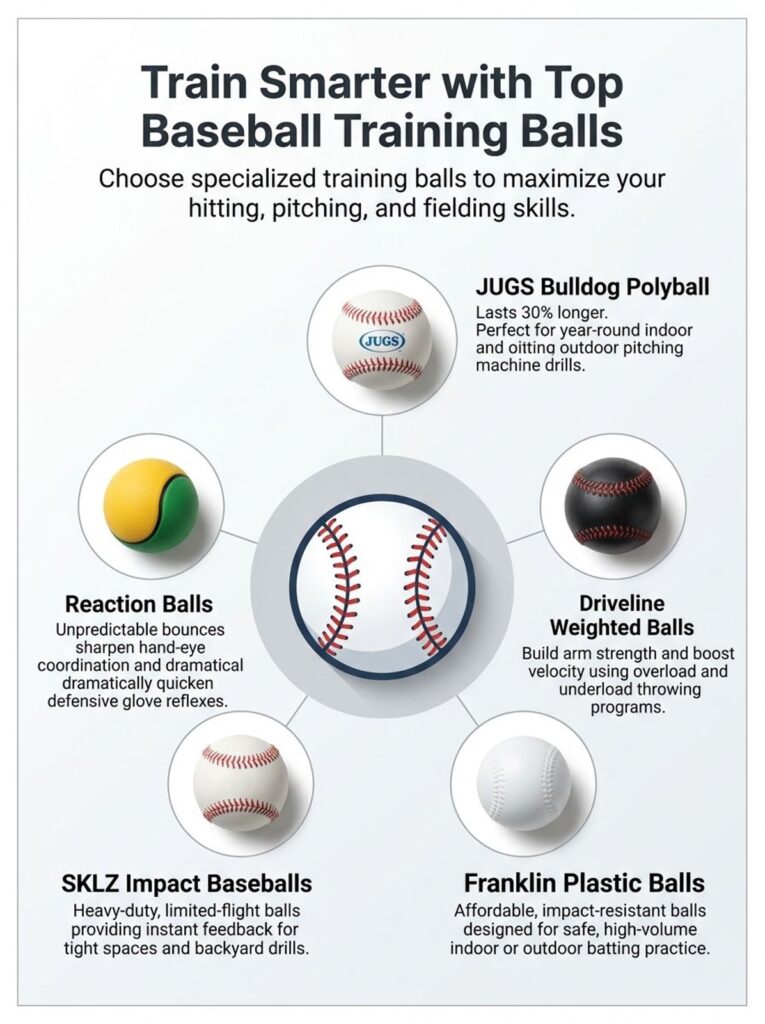
Table of contents
- Key Takeaways
- Key Features to Look for in Baseball Training Balls
- Best Overall Baseball Training Ball: JUGS Bulldog Polyball
- Best Weighted Training Ball: Driveline Weighted Baseballs
- Best for Hitting Practice: Franklin Sports Plastic Training Baseballs
- Best for Limited Flight Practice: SKLZ Impact Baseballs
- Baseball Training Balls Are Priceless (In My Opinion)
- FAQs About Training Baseballs
- References
Key Takeaways
- JUGS Bulldog Polyball is regulation sized, works well for pitching machines, and JUGS says it lasts up to 30% longer than other polyballs.
- Driveline weighted baseballs come in six weights, from 3 to 11 ounces, and are recommended for ages 14 and up, which makes them a better fit for advanced throwing plans than casual catch play.
- Franklin Sports plastic training balls are a strong budget pick for high-volume hitting, especially if you want safe reps indoors, in the yard, or during soft toss.
- SKLZ Impact Baseballs give instant contact feedback, hold shape after repeated swings, and keep flight down, but they do not fly like a regulation baseball.
Key Features to Look for in Baseball Training Balls
Start by matching the ball to the drill, not the label on the package. If you train in tight spaces, limited-flight poly balls make more sense than full-distance practice baseballs. If your goal is velocity, Driveline weighted baseballs belong in short, measured sessions with recovery built in.
- Use poly or limited-flight balls for batting cage balls, small yards, and pitching machine work.
- Use plastic baseballs or foam training balls for youth reps, indoor swings, and lower-risk contact work.
- Use weighted balls for advanced arm-speed, overload, and underload training.
- Use spin and reaction trainers when the drill is about release, hand-eye coordination, or first-step reads.
That simple filter keeps your practice sharper and stops you from buying a training aid that solves the wrong problem.
What materials make baseball training balls durable?
Material tells you how a ball will hold up and what kind of feedback you will get from it. Poly balls, such as the JUGS Bulldog, use a rigid shell and uniform hole pattern, so they feed cleanly through machines and keep shape better than thin plastic practice balls.
Bulldog Poly Baseballs are around $30 per dozen, and the Lite-Flite machine was specified for Lite-Flite or JUGS Poly balls only. If you run machine work several days a week, that kind of compatibility matters just as much as durability.
- Rigid poly shells: Best for machine work and repeated cage reps. JUGS Bulldog also matches regulation baseball dimensions, which helps timing transfer.
- Flexible plastic: Best for safe batting practice. Franklin’s 9-inch Indestruct-A-Ball flexes on impact, cuts flight, and Franklin says it lasts five times longer than traditional plastic practice balls.
- Dense pop-back plastic: Best for contact feedback. SKLZ Impact Practice Baseballs use a bumper-like material that resists cracking after thousands of swings.
- Leather covers with weighted cores: Best for advanced throwing work. They feel closer to a real baseball, but they also demand better mechanics and smarter recovery.
If you practice indoors or hit around windows, plastic training balls and limited-flight balls usually beat standard practice baseball. If you live on a pitching machine, a durable poly ball is the safer long-term buy.
What are the differences between standard and weighted baseball training balls?
A standard training baseball is built to mirror game feel. A weighted baseball changes the load on your arm, which can help velocity development, but it also changes how your body moves.
| Category | Standard Training Balls | Weighted Training Balls |
| Typical weight | About 5 ounces, which keeps the feel close to a regulation baseball. | Often 3 to 4 ounces for underload work, and 6 to 11 ounces for overload work. |
| Primary purpose | Game transfer, timing, command, and barrel accuracy. | Arm-speed stimulus, strength-demanding throws, and velocity-focused blocks. |
| Best use | Batting practice, bullpens, fielding work, and live-read reps. | Short, structured throwing sessions with planned intensity. |
| Skill transfer | Highest carryover to real baseball because the weight and feel stay familiar. | Useful for overload and underload adaptation, but standard balls still need to carry most of your weekly volume. |
| Who fits best | Every player, especially youth athletes and players rebuilding mechanics. | Experienced pitchers who can follow a written program and stop before fatigue changes mechanics. |
| Main risk | Low if your total throwing volume makes sense. | Easy to overdo, especially if you stack them on top of heavy bullpens or sore-arm weeks. |
Sports medicine research shows both sides of the trade-off: a 2018 six-week study found a 3.3% velocity gain in high school pitchers using a weighted-ball program, while a 2025 pilot study in professional pitchers reported a higher arm injury rate among weighted-ball users, 11.8 versus 7.5 per 1,000 pitching game exposures.
RELATED: SKLZ Fielding Trainer Review — Field Baseballs at Home
Treat weighted training like extra throwing stress. If you would not log it, you probably should not add it.
That is why standard balls should still dominate your weekly reps. Weighted training works best as a focused block, not as filler volume after a bullpen.
Which baseball training balls are the best training aids for hitting, pitching, and fielding?
Using current direct prices from JUGS, Franklin, SKLZ, Bownet, and Driveline, this is the clearest way to match a ball to your job. That said, you can always get almost everything listed cheaper on Amazon.
| Skill | Best Balls | Why | Typical Direct Price, June 2026 |
| Hitting, high-volume reps | Franklin Aero-Strike Plastic Baseballs; Franklin Indestruct-A-Ball | Lightweight, bright, and safe for tee work, front toss, and quick batting practice in tight spaces. | $14.99 for the Aero-Strike 8-pack; starting at $11.99 for Indestruct-A-Ball |
| Hitting, contact feedback | Bownet Snap Back Training Balls; Orange Squeeze Training Balls | Both give immediate feel on off-center contact. Snap Back collapses and pops back, while Orange Squeeze uses a smaller sweet spot. | $21.99; $34.99 |
| Pitching, velocity block | Driveline Weighted Baseballs; Ballast Weighted Ball | Driveline gives a true baseball feel across multiple weights. Ballast adds heavy resistance for strength-focused drills. | $16 to $85; $9.49 |
| Pitching, spin and release | Spin Vision Baseball | The ball turns purple when thrown with enough RPM and shows grip and backspin issues fast. It is especially useful for players 12 and under. | $34.99 |
| Fielding, hands and reaction | SKLZ Reaction Ball; Bownet Hollow Flex Training Balls | Reaction Ball creates unpredictable hops. Hollow Flex gives safer short-hop and hand-speed reps. | $11.99; $54.99 |
| Limited-flight backyard or cage work | JUGS Bulldog Polyball; SKLZ Impact Baseballs | Both keep reps tight and reduce chase time. JUGS is stronger for machine work, while SKLZ gives firmer contact feedback. | $30 per dozen; $24.99 |
A simple pro move is to keep one bucket for limited-flight balls and one for standard-feel balls. That split keeps tee work efficient and saves your more realistic practice baseballs for bullpen days, field reads, and live batting practice.
How do baseball training balls help improve feedback and performance?
The best training balls do more than reduce flight. They tell you what happened on the rep.
- Contact feedback: SKLZ Impact, Snap Back, and Orange Squeeze all react differently on off-center contact, so you know fast if you clipped the ball or barreled it.
- Spin feedback: Spin Vision shows whether you created clean backspin, which helps young pitchers spot bad hand position without guessing.
- Workload feedback: Weighted baseballs magnify poor timing. If your arm path gets rushed or your finish pulls off line, the ball exposes it.
- Reaction feedback: A reaction ball creates bad hops on purpose, so your first step, glove prep, and hand-eye coordination improve under pressure.
Track one result per drill. Hitters can chart flush contact rate, pitchers can log strike percentage or radar readings, and fielders can count clean picks in a one-minute set. That keeps the training ball from becoming a gimmick.
Best Overall Baseball Training Ball: JUGS Bulldog Polyball
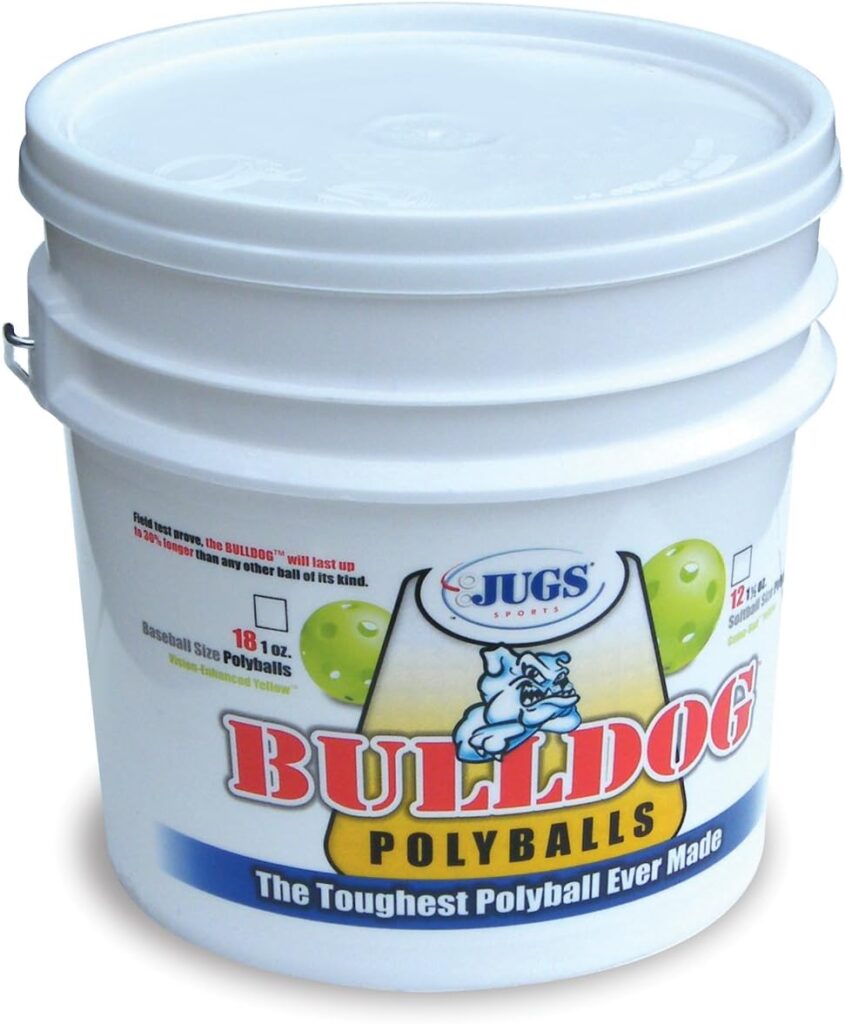
If you want one training ball that covers the most situations, the JUGS Bulldog Polyball is the easy pick. It works for pitching machine feeds, front toss, and small-space batting practice without the short lifespan that ruins cheap poly buckets.
What are the key features of the JUGS Bulldog Polyball?
The Bulldog earns its spot because it solves the two biggest practice problems, cracked shells and wild machine flight. JUGS builds it with a rigid polyethylene shell, uniform holes, and regulation baseball dimensions, so you get repeatable feeds and a truer look out of the machine.
- Machine friendly: The uniform hole pattern keeps air resistance more consistent, which helps location and timing.
- Longer life: JUGS says Bulldog Poly Baseballs last up to 30% longer than other polyballs.
- Indoor or outdoor use: The lighter build cuts sting and makes cage work safer.
- Better visibility: The Vision-Enhanced Yellow option is easier to track in mixed light.
For players who hit several times a week, the value is simple: fewer split balls, fewer bad feeds, and more useful reps from every bucket. If you want quality training balls for hitting, these are it.
What are the pros and cons of the JUGS Bulldog Polyball?
On the official JUGS store, a dozen Bulldog Poly Baseballs were listed at $30, which puts them in a strong middle ground between bargain poly balls and more specialized machine balls.
| Pros | Cons |
| – Lasts up to 30% longer than other polyballs. – Safe for indoor or outdoor batting practice. – Feeds well through many pitching machines. – Regulation size helps timing transfer better than undersized training balls. – Works for hitting, soft toss, and warmup fielding reps. | – Still lighter than a true game baseball. – Does not give real seam feel for advanced pitching work. – Not the best choice if you want exact fly-ball carry. – You still need to confirm machine compatibility before use. |
Best Weighted Training Ball: Driveline Weighted Baseballs
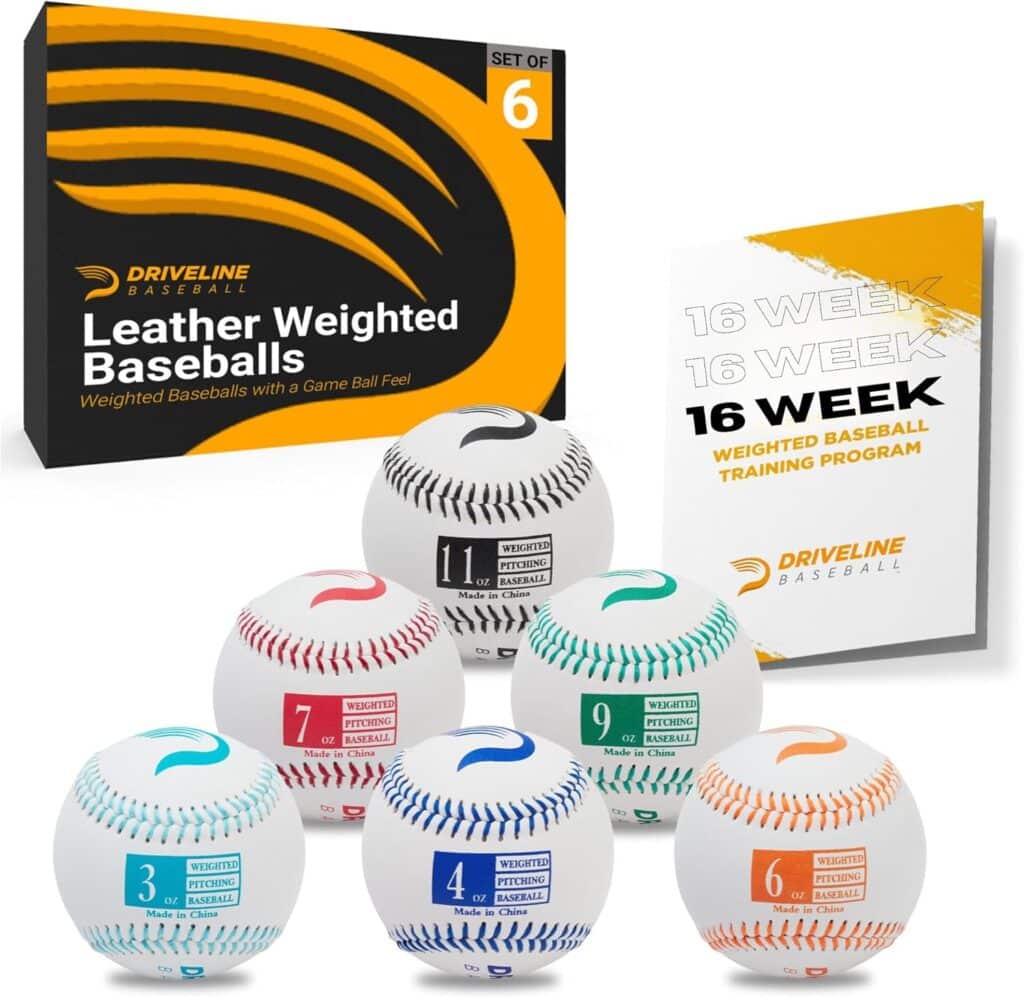
Driveline Weighted Baseballs are the best weighted training balls if your goal is more arm speed and a clearer overload-underload plan. They feel closer to a real baseball than soft plyo balls, which helps advanced pitchers keep the drill specific.
I’ve been using weighted baseballs with my teams and kids for years, and I’ve seen a massive difference. This is one of the balls for baseball you need if you want to improve your arm strength and power. This is a piece of baseball training equipment that is worth every penny.
What features define Driveline Weighted Baseballs?
Driveline sells these leather weighted baseballs in six weights: 3, 4, 6, 7, 9, and 11 ounces. That spread lets you move lighter than a standard 5-ounce baseball for arm-speed work or heavier for overload throws.
- Game-ball feel: Leather cover and baseball seams make catch play and command work feel familiar.
- Clear progression: Multiple weights let you pair underload and overload days instead of guessing.
- Best for older players: Driveline recommends the product (weighted balls for baseball) for ages 14 and up.
- Flexible buying: On Driveline’s store in June 2026, prices ranged from $16 for individual balls to $85 for the full set.
You do not need a huge setup to start. A light ball, a heavy ball, a regulation baseball, and a written throwing plan are enough to tell you whether weighted training is helping or just adding stress.
Additionally, you can use weighted baseballs for hitting if you want as well.
What are the advantages and disadvantages of Driveline Weighted Baseballs?
Weighted baseballs can improve velocity, but they are not casual warmup tools. They work best when you cap volume, keep intent high, and stop as soon as mechanics or recovery drop.
| Advantages | Disadvantages |
| – Can improve arm speed and support velocity-focused blocks. – Multiple weights make overload and underload training easier to organize. – Leather feel gives better carryover than soft training balls. – Useful for advanced command and catch-play variations. | – Higher stress than standard training baseballs. – Easy to misuse if you already throw a heavy weekly volume. – Not a good fit for players with arm pain, poor mechanics, or weak recovery habits. – Needs supervision or a clear plan to stay productive. |
A 2018 six-week study found a 3.3% velocity gain in high school pitchers, but a 2025 pilot study in professional pitchers reported a higher arm injury rate among weighted-ball users. Use weighted balls as a program, not as a toy.
RELATED: How To Increase Baseball Throwing Speed and Pitch Velocity
If you are still building mechanics, standard balls should handle most of your throwing work. Weighted training is a supplement, not the base.
Best for Hitting Practice: Franklin Sports Plastic Training Baseballs
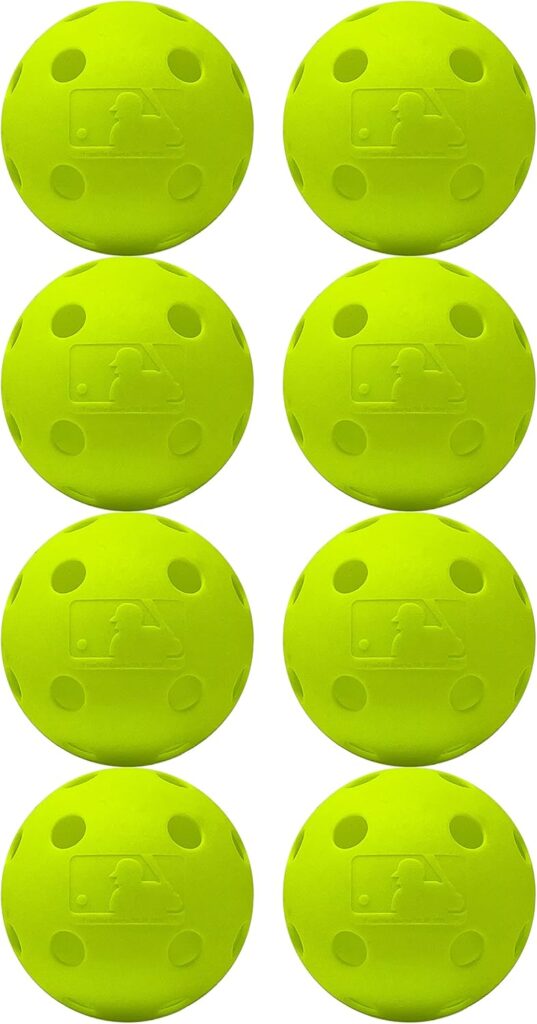
Franklin Sports Plastic Training Balls are the best pure hitting-practice pick for most players because they are cheap, bright, safe, and easy to replace. If your goal is swing volume, a few practice balls give you more reps per dollar.
What makes Franklin Sports Plastic Training Baseballs ideal for hitting practice?
Franklin makes two useful versions for hitters. The Aero-Strike Plastic Baseballs are solid plastic balls sold in an 8-pack, while the Indestruct-A-Ball line flexes on impact to reduce cracking and limit flight.
- Budget friendly: Franklin’s Aero-Strike 8-pack was listed at $14.99.
- Safer for repeated reps: The lightweight build works well for tee work, front toss, and younger hitters.
- Easy to track: Bright yellow color helps hitters pick up the ball early.
- Machine option: Franklin says the Aero-Strike balls are compatible with Franklin pitching machines.
If you mostly train in a yard, garage, or small field, these plastic baseballs keep practice moving. You spend more time swinging and working on baseball hitting and less time walking down full-distance balls. Also, they won’t break apart as quickly as foam baseballs.
What are the benefits and drawbacks of Franklin Sports Plastic Training Baseballs?
The strongest case for Franklin is volume. For hitters building rhythm, timing, and hand-eye coordination, safe reps matter more than perfect ball flight every day.
| Benefits | Drawbacks |
| – Low cost makes them easy to replace or buy in multiples. – Lightweight construction lowers risk during batting practice. – Bright color helps visual tracking. – Good fit for indoor work, backyard sessions, and young hitters. | – Do not feel like a regulation baseball at contact. – Flight is lighter and less realistic for advanced hitters. – Less useful for pitching drills or game-read fielding practice. – Older hitters may want firmer feedback at least once or twice a week. |
If you are an older player or you want more precise contact feedback, pair Franklin plastic balls with a firmer, limited-flight trainer on a second day. That gives you volume on one day and sharper feedback on the next.
Best for Limited Flight Practice: SKLZ Impact Baseballs
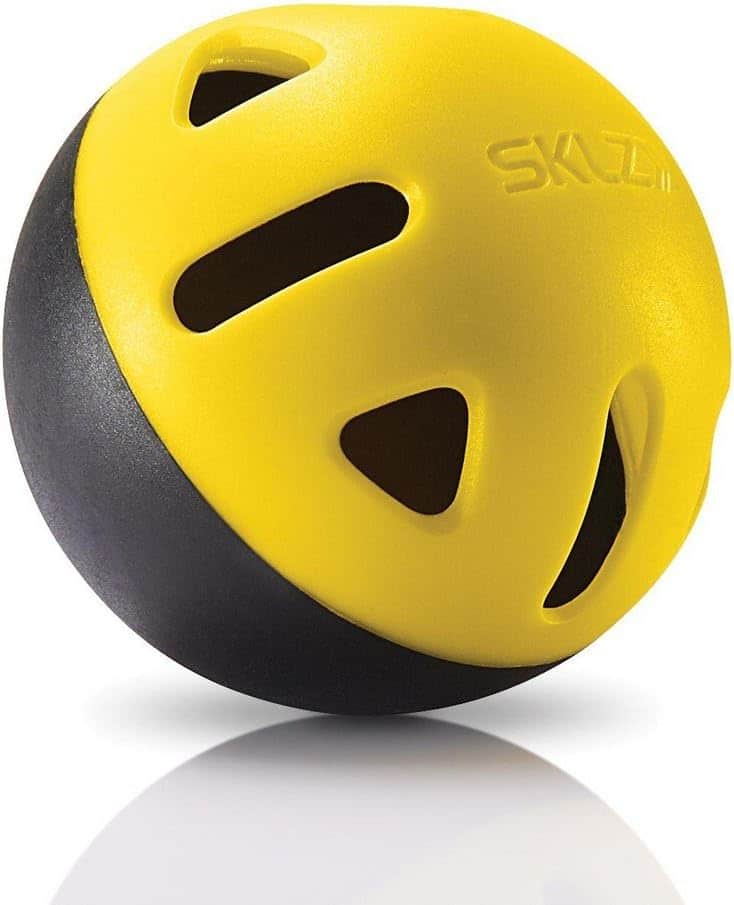
SKLZ Impact Baseballs are the best limited flight training balls if you want more feedback than a hollow plastic ball, but do not want the distance of a real baseball. They are especially useful for backyard tee work, short toss, and compact cages.
What features do SKLZ Impact Baseballs offer for limited flight practice?
SKLZ Impact Baseballs use a dense pop-back material that keeps shape after repeated contact and gives hitters instant feedback. On the official SKLZ store, the standard Impact Practice Baseballs were listed at $24.99.
- Instant feedback: Miss the barrel and you feel it right away.
- Limited flight: The ball stays in smaller practice areas.
- Durable shell: SKLZ says the material resists cracking even after thousands of swings.
- High visibility: The bright color helps with tracking and hand-eye work.
A smart setup is to keep Impact balls for tee work and front toss, then switch to standard balls for live reads. That split protects your practice space without teaching you to expect limited-flight carry on every swing.
They have an all-rubber version as well as a plastic. Which do I prefer? I actually like the all-rubber version better when working with my team as well as my own kids.
What are the pros and cons of SKLZ Impact Baseballs?
These balls give a better feel than cheap hollow plastic, but they still change the flight. Use them to clean up contact, not to judge real carry or game-ready launch.
| Pros | Cons |
| – Excellent contact feedback for hitters. – Durable enough for repeated batting practice. – Limited flight keeps backyard sessions manageable. – Bright color improves tracking. – Good fit for baseball training in tight spaces. | – Does not mimic regulation ball flight. – Less useful if your drill depends on true carry or seam action. – Heavier feel than very light plastic training balls. – Not the best choice for players who want exact game-read outfield reps. |
Baseball Training Balls Are Priceless (In My Opinion)
The best baseball training balls make practice more specific. They save reps, protect your space, and give you feedback you can actually use.
RELATED: Youth Baseball Hitting Drills to Improve Your Play
If you want one do-most pick, start with the JUGS Bulldog Polyball. If your priority is cheap batting practice, Franklin plastic balls win; if you need limited-flight feedback, SKLZ Impact stands out; if you want velocity work, Driveline weighted baseballs belong in a structured plan.
Match the ball to the drill, keep your volume honest, and your baseball training balls will help you get more from every session.
As a side note, if you are a brand that sells baseball gear (gloves, bats, catcher’s gear, elbow/ankle guards, training aids, etc.), we would love to work with you on content and get your products featured. If you’re open to it, please contact us and let’s discuss how we can get your baseball products in our content.
FAQs About Training Baseballs
Use the right ball for the drill and the sport, whether baseball. Pick a pitch training baseball for pitchers and a pro mini for short toss for swing work.
Yes, they last longer and cut pain, especially the mlb® indestruct-a-balls micro baseball or a maximum velocity, light-weight, sting-free practice baseball. Durable balls like leatherlast hold up in hard use.
Yes, baseball spinner trainers aid bat speed and control, while a bullet ball or jugs pearl can sharpen pocket feel and release. Using the right tool speeds skill gains.
Yes, Bownet sports gear, a bow net, and many pitchers use Jugs Pearl with launchers and net trainers from Champro or Diamond brands. Test one setup, then tune speed and angle.
No, many practice balls work for other sports drills, like soccer, golf, or basketball skill reps, and some are sold as multi-sport trainers.
References


*Disclosure: This article may contain affiliate links or ads, which means we earn a small commission at no extra cost to you if you make a purchase through these links. These commissions help support the operation and maintenance of our website, allowing us to continue producing free valuable content. Your support is genuinely appreciated, whether you choose to use our links or not. Thank you for being a part of our community and enjoying our content.
PLEASE CONSIDER SHARING THIS ON YOUR SOCIAL MEDIA TO HELP OTHERS LEARN MORE ABOUT THIS TOPIC.