
AstraGin Absorption Ingredient Benefits
As a certified sports nutritionist and strength coach, I often have my athletes bring in supplements. A question I see on occasion is, “What is this ingredient and what does it do?” Sometimes, that ingredient is AstraGin.
First off, if you buy a supplement and don’t know the ingredients in it, you shouldn’t be buying it in the first place. But at least they are coming to me with questions that I can help them better understand.
Luckily for them, AstraGin is a great ingredient, and one that I wish was in more supplements.
Why?
Because if you are putting your hard-earned money into protein, creatine, and vitamins, poor absorption can be the quiet reason progress stalls.
Astragin, sold as patented AstraGin®, is a patented plant extract blend intended to help your gut move more nutrients from the intestinal lumen into circulation.
In this guide, I will explain what AstraGin is, how it supports nutrient absorption and gut health, what the research actually measures (including human data), and how to use it in a real-world supplement stack.
Disclaimer: This article is for informational purposes only and should not be used to treat or diagnose any condition. It is recommended that you speak with your doctor before starting any exercise program, making changes to your nutrition plan, or adding any new dietary supplements into your current regimen.
Key Takeaways
- What it is: AstraGin® is a patented extract from Astragalus membranaceus and Panax notoginseng, covered by US patent US8197860 B2.
- What it is standardized for: Industry documentation describes it as standardized to at least 1.5% total saponins, with marker compounds including astragaloside I and ginsenoside Rb1.
- What the best human numbers look like: In a small human pharmacokinetic dataset (N=24), AstraGin® increased arginine AUC by about 17.3% (304.24 vs 259.30 μmol·hr/L), and improved the Arg/ADMA ratio by about 167% (208.01 vs 77.91).
- Gut and microbiome outcomes exist, but sample sizes matter: A small randomized pilot trial in adults with ulcerative colitis used 100 mg per day (two 50 mg capsules) for three months and reported shifts in several gut microbiota groups and improved markers linked with barrier function, but the trial was completed by eight participants.
What is Astragin (AstraGin®)?
AstraGin® (sometimes written as Astragin® or Astragin™ on labels) is a patented, plant-based extract blend from Panax notoginseng and Astragalus membranaceus.
NuLiv Science developed the proprietary formulation, and US patent US8197860 B2 covers it.
If you are scanning a label, the practical identifiers are its saponin standardization and the presence of the trademarked name AstraGin® (not just generic astragalus root or ginseng extracts).
| What to look for | Why it matters to you |
|---|---|
| Standardized saponins (often listed as 1.5% total saponins) | Standardization helps keep the “active fraction” consistent from batch to batch, so your dose today is closer to your dose next month. |
| Marker compounds like astragaloside (from astragalus) and ginsenosides such as ginsenoside Rb1 (from notoginseng) | These markers are often used in quality documentation to verify identity and potency of botanical extracts. |
| Third-party sport testing (if you compete) | Informed Ingredient certification is a useful filter for athletes who want lower risk of contamination with banned substances. |
Dose-wise, you will see AstraGin most often in the 50 mg to 100 mg per day range, either as a standalone capsule or built into a pre-workout, greens product, probiotic, or multivitamin.
For instance, a straight AstraGin® supplement can be helpful by itself, in a formula, or stacked with supplements you own to increase absorption.
How AstraGin Works
AstraGin® is positioned as an absorption ingredient, so its “job” is not to replace your protein, omega-3s, or vitamins.
Its job is to help your intestine do its job better: move nutrients through transporters and maintain a gut environment that supports healthy uptake.
The short version: AstraGin® has preclinical evidence of upregulating intestinal transport mechanisms (including transport proteins such as SGLT1 and CAT1), and it also has early human data showing changes in arginine exposure in blood.
How does AstraGin enhance nutrient absorption?
Many nutrients do not simply “soak through” the gut wall. They rely on transporter systems in the intestinal lining, plus adequate digestion and a stable gut barrier.
NuLiv Science’s research overview describes AstraGin® as supporting absorption in part by increasing the expression of transporters such as SGLT1 (a glucose transporter) and CAT1 (a transporter tied to cationic amino acids like l-arginine).
In the same overview, the company summarizes preclinical uptake changes that are helpful for a fitness audience because they map directly to common supplements.
- Fish oil PUFAs: reported up to +100% uptake in a preclinical model, which is relevant if you take omega-3s for recovery support.
- Flax oil PUFAs: reported +58% uptake preclinically, useful if you use plant-based omega sources.
- Folate: reported +50% uptake in a Caco-2 in vitro model, useful if your multivitamin includes folate.
How to use that in your stack: take AstraGin with the supplements where absorption is most likely to be the bottleneck, such as omega-3 softgels, curcumin products, amino acids, or a multivitamin taken with a meal.
How does AstraGin support gut wall integrity?
Your “gut wall” is not a single layer. It is an active barrier made up of intestinal epithelial cells, mucus, and tight junction structures that help regulate what passes through.
Those tight junction structures are often described using proteins such as occludin, claudins, and ZO-1. If you see a study discussing gut barrier integrity, these terms show up because they are part of how permeability is measured and explained.
A decision-driving detail here is that AstraGin has been tested in humans, with barrier-related outcomes measured, not just discussed.
According to a 2023 randomized, double-blind pilot trial in adults with ulcerative colitis (eight participants completed the trial), subjects received 100 mg per day (two 50 mg capsules) for three months, and the authors reported improved intestinal barrier integrity, along with changes in microbiota and immune markers.
Action step for you: if you are experimenting with a gut wall support ingredient like AstraGin, track one performance metric (training volume, soreness, or session quality) and one digestion metric (bloating, stool consistency, or post-meal comfort) for at least 4 to 8 weeks.
How does AstraGin promote microbiota balance?
Microbiome claims can get fuzzy fast, so it helps when a study names specific organisms and reports specific changes.
In that same 2023 pilot trial in ulcerative colitis, the intervention group reported increased beneficial bacteria populations, including Faecalibacterium prausnitzii (reported +420%) and Bifidobacterium adolescentis (reported +180%).
The study also reported that Enterobacteriaceae increased by only 14% in the intervention group, compared with 614% in the placebo group, and Prevotella decreased by 98%, compared with a 27% increase in the placebo group.
- So what for training: if your gut feels unpredictable, consistent intake of protein and carbs gets harder, and your recovery nutrition suffers.
- So, what about supplement timing: if you take a probiotic, AstraGin is often positioned as a companion ingredient because the goal is a more supportive gut environment, not just adding bacteria.
Practical guardrail: microbiome results from a small cohort are a starting signal, not a guarantee. Use them to guide a trial period, then decide based on your own digestion and training consistency.
How does AstraGin strengthen the immune system?
A lot of your immune function is tied to your gastrointestinal tract because the gut is a major site of immune tissue and immune signaling.
In immunology, the term gut-associated lymphoid tissue (GALT) is often used to describe this, and it is often summarized as accounting for around 70% of immune tissue by mass.
For fitness enthusiasts, the practical angle is simple. If your gut barrier and microbiome are under stress, you may end up spending more of your “recovery budget” managing that stress than adapting to training.
If you want the most grounded way to use AstraGin for immune support, focus on the mechanism that is easiest to measure: improved nutrient absorption, steadier digestion, and better compliance with your protein, micronutrient, and omega-3 routine.
Key Benefits of AstraGin
Most people add AstraGin to a dietary supplement stack for one reason: to increase the absorption of ingredients they are already taking.
For a health and fitness audience, the benefits tend to fall into three buckets: amino acid uptake (training and recovery), fatty acid uptake (omega-3 delivery), and gut health (comfort and consistency).
How does AstraGin improve amino acid absorption?
If your goal is performance, amino acids matter because they are the building blocks of muscle protein synthesis and recovery.
In preclinical in vitro data summarized by NuLiv Science, AstraGin® was associated with higher amino acid uptake, including arginine and leucine, and increased protein synthesis signaling linked to mTOR.
| Evidence type | What was measured | Why you should care |
|---|---|---|
| Human pharmacokinetic data (N=24) | Arginine AUC increased about 17.3% (304.24 vs 259.30 μmol·hr/L) | More exposure to l-arginine can matter if your pre-workout relies on arginine-related nitric oxide pathways. |
| Human pharmacokinetic data (N=24) | Arg/ADMA ratio increased about 167% (208.01 vs 77.91) | ADMA is commonly discussed as a nitric oxide synthase inhibitor, so this ratio is often used as a nitric oxide related context marker. |
| Small pilot trial (ulcerative colitis) | Reported 49.7% higher l-arginine absorption vs placebo | This suggests absorption effects can show up in humans, though the sample size was small. |
How to apply it: if your pre-workout contains l-arginine (or your diet is low in protein quality), AstraGin can be a “support ingredient” you take with the dose that matters most to you, often pre-workout or with your highest-protein meal.
How does AstraGin enhance fatty acid absorption?
Omega-3 products fail in two common ways: inconsistent intake and poor absorption related to digestion, emulsification, or timing.
In preclinical data summarized by NuLiv Science, AstraGin® was associated with increased uptake of several fatty acid categories, including fish oil PUFAs (+100%) and flax oil PUFAs (+58%).
It also reported increased uptake of linoleic acid (+41%), hemp oil fatty acids (+28%), and an omega-7 signal (+38%) in the same preclinical summary.
- Simple tactic: take your fish oil with a meal that contains fat, and take AstraGin at the same time.
- Consistency tactic: tie it to the meal you rarely skip, often lunch or dinner, not a “perfect” timing window.
How does AstraGin increase vitamin and phytonutrient uptake?
Phytonutrients often struggle with bioavailability because many are poorly water soluble or rely on specific carrier systems.
In a preclinical summary from NuLiv Science, curcumin uptake increased by up to 92% in a model pairing curcumin with lecithin, and folate uptake increased by 50% in a Caco-2 in vitro model.
How to apply it: if you take curcumin, pair AstraGin with a curcumin product that already uses a delivery system (such as a phospholipid style formulation), then keep the routine steady for a few weeks before judging it.
How does AstraGin support gut health and digestion?
If your digestion is unpredictable, the best supplement stack in the world still underperforms because you cannot use it consistently.
That is the practical appeal of an ingredient focused on the healthy gut lining and nutrient transporters, it targets the “delivery system,” not just the payload.
In the 2023 randomized pilot trial in ulcerative colitis, researchers measured blood and stool markers and reported improvements in barrier function, inflammation indicators, and named microbiota shifts after 3 months of use at 100 mg per day.
Best way to test it: run a structured 8 to 12-week trial, keep your protein intake stable, and avoid changing multiple gut-active products at once (new probiotics, high-dose magnesium, or big fiber changes) so you can interpret the results.
Research-Supported Benefits
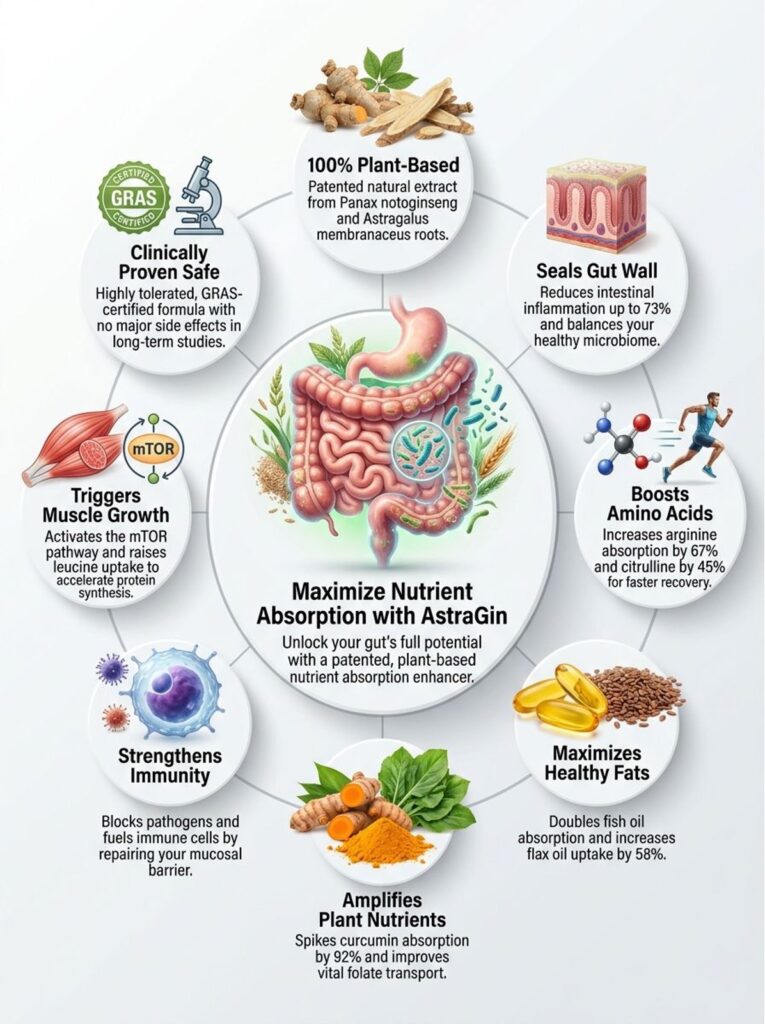
If you want to evaluate AstraGin like a serious athlete, focus on the type of evidence, not the marketing claim.
You will see three common evidence types: transporter work in Caco-2 cells, animal models (often rats), and a smaller number of human datasets and pilot trials.
What are the amino acid absorption improvement percentages?
Here are the clearest human numbers that have been shared publicly in summary form for l-arginine and related markers.
| Metric | Placebo | AstraGin / APS | What it can mean for you |
|---|---|---|---|
| Arginine AUC (μmol·hr/L) | 259.30 | 304.24 | About +17.3% arginine exposure in this dataset, which may support pre-workout formulations built around arginine pathways. |
| Arg/ADMA ratio | 77.91 | 208.01 | About +167% in this dataset, often discussed as a nitric oxide related context marker. |
- Important context: a “better blood marker” is not automatically a better pump, better endurance, or faster recovery. You still need the right dose of the main ingredients.
- Best use case: stacks with amino acids (EAAs), protein, creatine, and pre-workout formulas where absorption can be a limiting step.
What are the fatty acid absorption improvement percentages?
Here are fatty acid absorption changes commonly reported in preclinical models.
| Fatty Acid Type | Source | Absorption Change | Notes |
|---|---|---|---|
| Polyunsaturated fatty acids | Flax oil | +58% | Preclinical summary figure, useful as a “directional” indicator for plant-based omega intake. |
| Polyunsaturated fatty acids | Fish oil | +100% | Preclinical summary figure, relevant if you use omega-3s for recovery support. |
| Linoleic acid | Dietary oils | +41% | Preclinical summary figure. |
| Omega-7 fatty acid | Omega-7 sources | +38% | Preclinical summary figure. |
Practical filter: if you already take your fish oil with a meal and feel fine digestively, AstraGin is more of a “fine-tuning” ingredient. If fish oil repeats on you, or you take it on an empty stomach, fix timing first.
How much does AstraGin increase folate absorption rates?
Folate shows up often in AstraGin content because it is a nutrient that relies on intestinal transport systems, and it is common in multis and greens products.
| Topic | Key Points for You |
|---|---|
| Evidence Type | – Caco-2 in vitro models are used to study intestinal uptake and transporter behavior. – A preclinical summary figure reports folate uptake at +50% with AstraGin in an in vitro model. |
| Mechanism | – AstraGin is presented as supporting transporter expression, including transport proteins such as SGLT1 and CAT1. – Transporter changes are one plausible reason absorption changes can occur in models. |
| How to Use | – Take AstraGin with your multivitamin or a folate-containing product, ideally with a meal. – Keep your routine stable, so you can judge changes in energy, digestion, and training consistency. |
How does AstraGin enhance phytocompound absorption?
Curcumin is a useful example because it is widely used and well known for its bioavailability issues.
In a preclinical summary figure from NuLiv Science, curcumin uptake increased by up to 92% in a model in which curcumin was paired with lecithin.
- Action step: if you use curcumin, favor a formula that already uses a delivery system (often phospholipid-based), then use AstraGin alongside it.
- Pitfall to avoid: changing curcumin brand, dose, diet, and probiotic routine at the same time, which makes the “absorption” question impossible to answer.
What does an improved lactulose/mannitol ratio indicate?
The lactulose/mannitol (L/M) urine test is a common, noninvasive method for estimating intestinal permeability.
In simple terms, a higher lactulose-to-mannitol ratio is commonly interpreted as a leakier intestinal barrier, suggesting that a higher L/M ratio can reflect increased intestinal permeability.
Timed urine collections vary by protocol and lab kit. Many collection instructions use a timed window (often a few hours, with some kits using a 6-hour collection).
Why this matters: if you are reading AstraGin study summaries, check whether the L/M ratio moved in the direction associated with improved barrier function (often a lower ratio), and whether the study population was healthy adults or people with gut conditions.
Applications of AstraGin
AstraGin is most often used in sports nutrition, functional foods, and nutraceutical products because it can be dosed in small amounts and is intended to support absorption.
How is AstraGin used in sports nutrition supplements?
In sports nutrition, AstraGin is commonly paired with protein, EAAs, and pre-workout formulas where amino acid uptake and l-arginine uptake are central to the “feel” of the product.
A practical dosage range you will see is 50 mg to 100 mg per day, with some product sheets listing a recommended 50 mg serving.
- Pre-workout: take AstraGin with your nitric oxide focused ingredients (like l-arginine), especially if your stomach is sensitive.
- Post-workout: take it with protein or EAAs for absorption support tied to recovery nutrition.
- Daily health stack: pair it with a multivitamin and omega-3s to support nutrient absorption consistency.
How is AstraGin incorporated into functional foods and beverages?
AstraGin can be used in RTDs, powdered drink mixes, bars, gummies, and gels because the dose is small and it is meant to fit inside multi-ingredient formulations.
If you use functional beverages, the clearest “win” is pairing AstraGin with ingredients that commonly struggle with bioavailability, such as curcumin, omega-3 oils, or certain botanical extracts.
- Best match: products that already include emulsifiers or phospholipids, since fat-soluble ingredients often benefit from better dispersion.
- Best timing: take with food when the product includes fat-soluble compounds.
What role does AstraGin play in nutraceutical products?
In nutraceutical formulations, AstraGin is typically included as a supporting ingredient to enhance the absorption of amino acids, fatty acids, vitamins, and phytocompounds.
That can matter for compliance: if your digestion feels smoother and your stack feels more consistent, you are more likely to stay on plan long enough to get results.
How does AstraGin benefit animal health products?
Some product sheets list AstraGin as an ingredient that can be used in pet and livestock nutritional products, with the same basic intent: support nutrient uptake through the gastrointestinal tract.
If you are evaluating an animal health formula, the quality and safety checks (identity testing, microbial limits, contaminants) matter at least as much as the inclusion of an absorption ingredient.
Unique Features of AstraGin
AstraGin is not simply “astragalus root plus ginseng.” Its differentiation is the patented combination, standardization, and the way it is positioned to influence nutrient transporters and gut function measures.
What makes AstraGin a plant-based and natural formulation?
AstraGin is derived from two botanicals with long histories in traditional Chinese medicine: astragalus root and notoginseng root.
What makes it more “ingredient-like” than a typical herb capsule is that it is standardized and typically documented with marker compounds (saponins, astragaloside, and ginsenosides).
How is AstraGin derived from Panax notoginseng and Astragalus membranaceus?
The formulation is described as specialized extracts of Panax notoginseng (root) and Astragalus membranaceus (root) produced using a proprietary extraction approach.
The published safety documentation for this botanical extract describes specifications that include total saponins and marker saponins (ginsenoside Rb1 and astragaloside I), along with microbial limits.
| Specification category | Examples of what is typically listed |
|---|---|
| Identity and potency | Total saponins, plus marker saponins such as ginsenoside Rb1 and astragaloside I. |
| Microbial limits | Total plate count, yeast and mold count, and absence targets for pathogens such as E. coli and Salmonella. |
| Contaminants | Heavy metal limits and pesticide residue checks are commonly part of raw material quality programs. |
What clinical studies support AstraGin’s efficacy?
The most useful clinical signals for a fitness audience are the ones tied to measurable outcomes: arginine exposure (AUC), absorption markers, and gut-related measures.
Two human data points that keep showing up are the small pharmacokinetic dataset (N=24) with higher arginine AUC and Arg/ADMA ratio, and the 2023 randomized pilot trial in ulcerative colitis reporting microbiota shifts and barrier-related improvements at 100 mg per day for three months.
- If you want “pump” relevance: focus on the arginine AUC and nitric oxide-related context markers.
- If you want gut relevance: focus on barrier integrity outcomes and named microbiota shifts, while respecting the small sample size.
Safety and Tolerability
Safety conversations for botanicals should separate three topics: the safety of the raw material, the dose used, and the claims a finished product makes in marketing.
In the United States, AstraGin has been described in industry coverage as self-affirmed GRAS based on an expert panel review, which is different from receiving an FDA “no questions” letter for a GRAS notice.
What do clinical trials reveal about AstraGin’s safety?
Published safety assessments and product documentation describe AstraGin as food grade and used at small daily doses, often 50 mg to 100 mg.
If you are comparing absorption enhancers, a practical safety filter is whether the ingredient has identity specs, microbial limits, and a track record of use in finished products intended for daily intake.
How well do users generally tolerate AstraGin?
AstraGin is typically used at low milligram doses, and tolerance in published human studies has been reported without major adverse events, though the datasets are not large.
If you are sensitive to botanicals, start at the lower end (often 50 mg), take it with food for a week, and only scale up if your digestion feels stable.
- Talk to a clinician first if you are pregnant, breastfeeding, managing a medical condition, or using medications that affect blood clotting, since Panax species are commonly discussed in interaction warnings.
- Stop and reassess if you notice rash, unusual sleep disruption, or digestive discomfort that persists past the first week.
Why Choose AstraGin?
If you want one reason to choose AstraGin®, it is this: it is a standardized, patented absorption ingredient designed to support nutrient transporters and gut function markers, and it has early human data beyond cell and animal studies.
Why is AstraGin considered a superior bioavailability enhancer?
AstraGin is presented as working through your intestinal absorption pathways, including transporter support, rather than acting as a stimulant or a harsh irritant.
It is also commonly used at a small dose in multi-ingredient formulas, which makes it easier to fit into your routine than ingredients that require grams per day.
A smart way to judge “bioavailability enhancers” is to ask: does it have human data for a nutrient you care about (like l-arginine), and does it have gut-related outcomes that connect to real-world supplement consistency?
How effective is AstraGin in pre-workout and protein supplements?
In pre-workout products, AstraGin is most relevant when your formula leans on amino acids, especially l-arginine, and you want more consistent absorption and digestion.
In protein supplements, its value is more about making your post-workout routine easier to repeat day after day, which is what drives progress for most people.
- Use case: pre-workout stacks focused on nitric oxide signaling and recovery blends that include amino acids.
- Typical dose range: 50 mg to 100 mg daily, commonly taken with the product you most want to “work better.”
How does AstraGin support overall health and wellness?
AstraGin supports wellness through a gut-first pathway: better nutrient absorption, a healthier intestinal environment, and early human data showing microbiota shifts and barrier-related outcomes in a clinical setting.
If your goal is better training consistency, the best “wellness” outcome is often simple: fewer digestive speed bumps, better adherence to protein and supplement routines, and more predictable recovery habits.
Conclusion
If you want more return from the supplements you already take, Astragin (AstraGin®) is worth evaluating as an absorption and gut health support ingredient.
The simplest way to use it is: pair it with the nutrients you care about most, take a consistent daily dose for several weeks, and track digestion and training outcomes side by side.
Clinical and preclinical data point in the same direction: better uptake signals and gut support, but your results still depend on dose, product quality, and consistency.
FAQs
AstraGin is an absorption ingredient made from plant extracts and active compounds. It helps the gut absorb more nutrients, like vitamins, minerals, and amino acids.
It can boost nutrient absorption and raise the bioavailability of supplements, which may help your body get more from food and pills. Some studies show better uptake of amino acids and minerals, but it does not create nutrients on its own.
Most people tolerate this ingredient well, with few reported side effects. Talk to your doctor if you take medicines or have a health condition.
Follow the product label for the dose, and take it with the supplements you want to absorb better. For best results, combine it with a balanced diet and monitor how you feel.
References
- https://www.gaiaherbs.com/blogs/seeds-of-knowledge/astragin
- https://nulivscience.com/astragin-protein-absorption/
- https://pmc.ncbi.nlm.nih.gov/articles/PMC4047110/
- https://www.researchgate.net/publication/347929128_Potential_benefits_of_incorporating_Astragalus_membranaceus_into_the_diet_of_people_undergoing_disease_treatment_An_overview

*Disclosure: This article may contain affiliate links or ads, which means we earn a small commission at no extra cost to you if you make a purchase through these links. These commissions help support the operation and maintenance of our website, allowing us to continue producing free valuable content. Your support is genuinely appreciated, whether you choose to use our links or not. Thank you for being a part of our community and enjoying our content.
PLEASE CONSIDER SHARING THIS ON YOUR SOCIAL MEDIA TO HELP OTHERS LEARN MORE ABOUT THIS TOPIC.