
Does The Antimatter Wing Actually Improve Recoil Control?
If you haven’t heard of the Antimatter Wing, you’re missing out on one of the coolest gas pedals on the market for your pistol.
Let’s set the stage…
You’re at the range working on your skills. Your SIG P365 shoots flat enough at a slow pace, then the moment you start pushing speed, the muzzle wants to hop around like the Easter bunny at an egg hunt.
It sucks, right? You’re trying to track your sights or red dot, but all you’re doing is slowing things down so you don’t randomly send rounds downrange without any idea where they’re going.
It would be so much easier if there were something you could use to apply some downward pressure on the firearms to help keep the muzzle down.
That’s where the Antimatter Wing comes into play.
The whole pitch behind the Antimatter Wing is simple… it gives your support-hand thumb a repeatable ledge without forcing you into a giant competition holster setup.
You might be wondering how you can add a wing or ledge to your firearm and still use the same holster, right? That’s why I turned to the Antimatter Wing.
In this article, I’m going to break down what the Antimatter Industries Wing is, how it fits on a Streamlight TLR-7 sub setup, and what my 1,000-round live-fire check did, and did not, prove.
You’ll also get practical setup tips, common fit issues, and a clear “who it’s for” verdict.
Here’s the actual product on their website if you wanted a closer look.
Key Takeaways
- In our live-fire test (1,000 rounds), the Micro Wing by itself gave me a consistent, measurable improvement in muzzle rise or faster follow-up shots on a SIG P365.
- Antimatter Industries lists the Micro Wing for SIG P365/365 XL at $99, while standard retailer pricing is often closer to $120, so it’s worth deciding what you want to measure before you buy.
- The Micro Wing replaces the side lug on compatible Streamlight TLR-7 Sub models and works best if you actually drive an aggressive, forward-thumb grip into the ledge.
Key Features of the Antimatter Wing
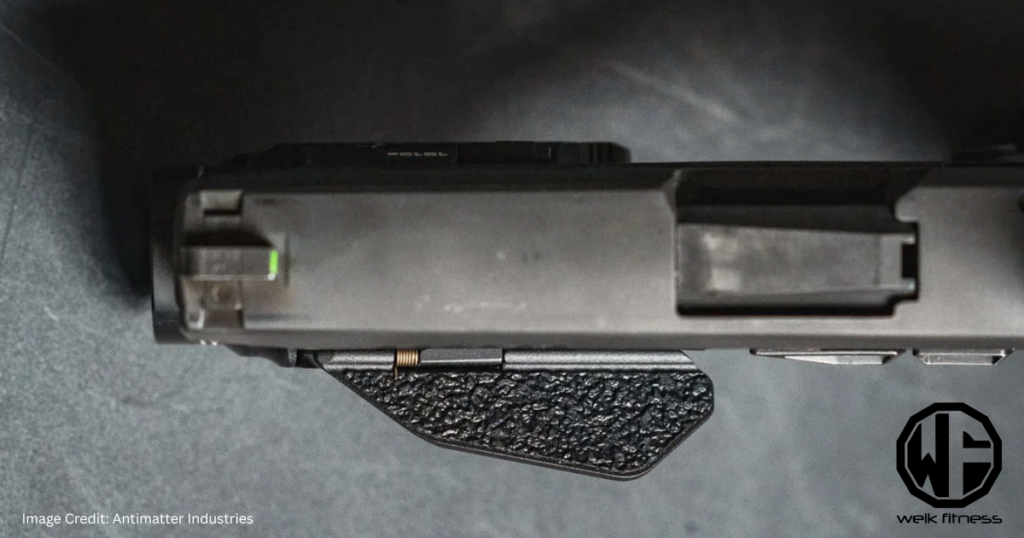
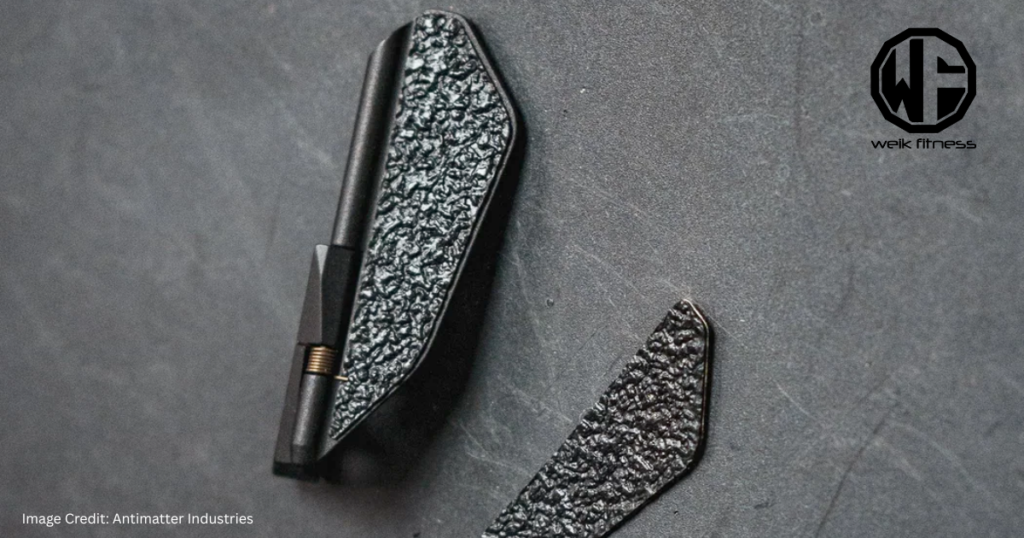
The Antimatter Industries Wing is a folding thumb ledge that mounts by replacing your weapon light’s side lug. The “so what” is grip consistency: if your support-hand thumb tends to float, the wing gives it a hard, repeatable index point so you can lock your wrist and drive the gun back down faster.
One important correction that changes expectations: Antimatter describes the Micro Wing as being machined from 7075-T6 aluminum, so you’re not buying a soft plastic add-on. What can feel like “flex” in fast strings is usually the folding behavior by design, not the actual material bending.
If you want a quick win, treat the wing like a grip coach, not a recoil cheat code. If your grip is already solid, you may not see a dramatic change on a small pistol like the P365.
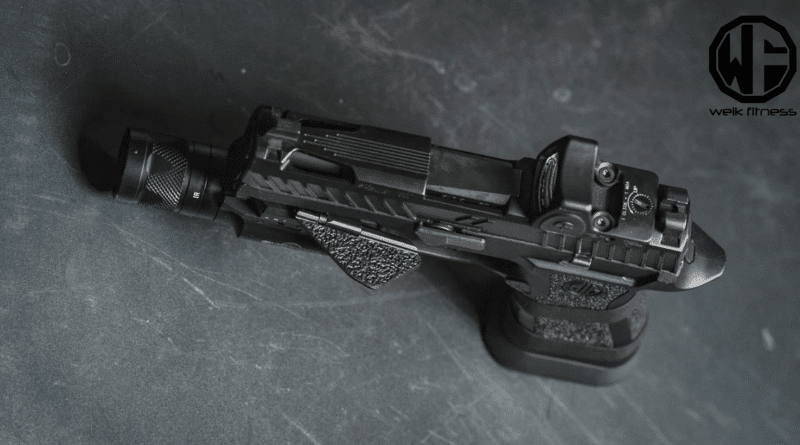
I put the Antimatter Wing on my Sig Sauer P365X that I turned into a Spectre Comp. I also tossed the grip module onto a standard X slide that I added a Radian Afterburner + Ramjet.
Honestly, both the Spectre Comp slide and the Radian combo side shot amazingly. That said, I felt the most improvement with the Radio Afterburner + Ramjet setup with the Micro Wing attached to the light.
What is the design and material composition of the Antimatter Wing?
The design is centered on an auto-deploying ledge: you draw, the wing flips out, and your support-hand thumb naturally lands on the same spot.
Antimatter states installation takes about 60 seconds, and you do not need a gunsmith or special tools, which makes it easy to test on your own gear without committing to permanent changes.
I found it super quick and easy to add the Antimatter Wing onto my WML.
Material matters because a wing is only useful if it stays consistent. Antimatter also sells grip tape so you can refresh traction when it gets slick from sweat, dust, or carry lint.
Here are the hands-on tips that made the biggest difference in how the Antimatter Wing “felt” on my Sig P365:
- Drive forward, not down: if you only press down, you can dip the muzzle and throw shots low. Push your thumb forward to lock the wrist.
- Build the grip in the holster: get your support hand moving into position early so the thumb finds the ledge during presentation, not after the first shot.
- Practice the fold before live fire: run slow, safe reps so you can collapse the wing consistently during one-handed re-holstering.
- Check light tightness often: after the first range trip, re-check that the light and lug interface stays snug, especially if you shoot fast strings.
If you’re coming from a Glock to a P365, the wing can feel like a shortcut to “bigger gun leverage,” but it still rewards fundamentals. In my experience, the shooters who benefit most already have a consistent thumbs-forward grip and want a cleaner index point under stress.
Which firearms and accessories are compatible with the Antimatter Wing?
Compatibility is where most people waste time and money. The Micro Wing is not a universal gas pedal, it’s a specific part built around specific weapon lights and rail setups.
For P365 owners, the most important fit rule is this: Antimatter’s SIG version is listed as only compatible with the standard P365 and P365 XL, while the P365 XMacro, XMacro Comp, and AXG Legion require the 1913 version.
| What you have | What to confirm before buying | Why it matters |
|---|---|---|
| SIG P365 or P365 XL (standard rail setup) | Micro Wing variant made for the TLR-7 Sub SIG interface | This is the cleanest “drop-in” path for most P365 carry builds. |
| P365 XMacro family or other 1913 rail setups | Micro Wing 1913 Picatinny variant | The wrong wing will not seat correctly because the lug and rail geometry differ. |
| Surefire X300/X400 B series lights | X300 Wing compatibility and stock status | This wing targets duty-style setups, and holster fit becomes the big limiter. |
- The Micro Wing for SIG 365/365 XL frames pairs with the Streamlight TLR 7 Sub ecosystem, and Antimatter lists the SIG P365/365 XL Micro Wing at $99.
- Streamlight lists the TLR-7 X Sub at 500 lumens with a multi-fuel setup that can run on an SL-B9 rechargeable battery pack or a CR123A, which matters if your holster fit is already tight and you do not want to change the light body.
- The Micro Wing and X300 Wing are commonly paired with Flux Raider 365 builds for more contact area.
- If you want your optic forward on a Raider 365, the Forward Optic Mount is listed on Flux Defense’s product page and makes a huge difference in how much you need to bring your head down to see your red dot optic.
- If you plan to carry, choose holsters that lock on the light correctly. Streamlight explicitly warns against carrying a TLR-equipped firearm without a proper holster that fully covers the trigger guard.
- The Antimatter Kompact Wing for the TLR7 Sub is not necessary, but a great add-on if you want to shoot faster and keep your gun flat rather than experiencing muzzle flip.
Testing Recoil Control with the Antimatter Wing
If you want an honest answer on how the Antimatter Wing helps with recoil control, you need something to measure. In order to do this, I used the Mantis X10 system I have that tracks various metrics.
The Mantis X10 Elite “RecoilMeter” can quantify muzzle rise and recovery time. That’s a useful tool if you want numbers tied to recoil management instead of just “felt recoil.”
How does the Antimatter Wing perform in live fire scenarios?
I ran 1,000 rounds through my SIG P365 across various setups: factory barrel, compensator only (on the Spectre Comp and also Radian Afterburner + Ramjet), and compensators plus the Antimatter Micro Wing. The compensators made the clearest difference in how fast the gun settled between shots.
The Wing by itself did not show that much of an improvement in muzzle rise or practical recoil control, in my opinion. Did it help? Sure, a little. But does it warrant the $99 price tag if you don’t use a comp? I don’t think so.
The biggest limitation was consistency, the ledge only helped when the support-hand thumb hit the exact spot with the same forward pressure every time. Any change to the position of the thumb on the ledge can mean absolutely zero improvement.
So, I feel the Antimatter Wing requires some training (can even be through dry fire) to get the same thumb position rep after rep.
If you want to replicate this kind of test without turning your range day into a science project by using something like a Mantis X10, use a simple tool stack:
- Shot timer: A PACT Club Timer III highlights first shot and last split without button pushing, which makes it easier to run clean comparisons.
- Second option timer: The Pocket Pro II (which I personally like) is another great shot timer that you can use at the range to measure data.
- Video: Use slow-motion on your phone for a quick muzzle tracking check, then compare the same drill across setups.
If you want to prioritize raw muzzle control, it’s hard to argue against a true muzzle device. That’s why I kept the compensator combo with the Antimatter Wing on my P365.
I will say this though… the wing was comfortable and quick to index after just a few draws during dry fire. The placement felt natural (in my opinion) based on where I place my thumb when I grip the firearm.
Feedback about recoil control with the Antimatter Wing
Feedback on the Antimatter Wing tends to cluster into a few buckets: grip style, holster fit, and whether the light stays tight.
- I will say that I looked at many reviews before I purchased the Antimatter Wing, and many users report no noticeable recoil improvement on a SIG P365 when using the Antimatter Wing alone, especially with a neutral support-hand thumb.
- Shooters who use an aggressive forward thumb position are the ones most likely to report a real benefit, because they can apply consistent forward pressure into the ledge.
- Some users online reported that the light or wing can work loose during shooting on certain frames, which turns the range session into a constant hardware check instead of practice.
- Holster fit is a common theme. Several users say loosening retention helps, and some report carefully heating and reforming Kydex for a cleaner draw and re-holster cycle.
- I use various holsters and can say I have no issues at all with fitment.
- Others point out that if you already run a compensator or a tuned setup, the wing can feel redundant, and in a few cases, it can even encourage “pushing the gun down” if you overdrive the thumb.
- In my tests, I found the combo of a compensator and the wing provided the most noticeable improvements.
Advantages and Limitations of the Antimatter Wing
The Antimatter Wing can be a smart carry-focused recoil aid if you treat it as an indexing tool. It can also be a frustrating purchase if you expect it to replace fundamentals or fix a loose light setup.
If you suck at shooting, you’ll spend $99 and still suck at shooting. This won’t “make you a better shooter” if your fundamentals aren’t solid.
The best way to think about the use of the Antimatter Wing is leverage. It gives you a consistent place to apply support-hand pressure, but it cannot magically add weight to your slide or change your recoil impulse the way a compensator can.
Locking out your support hand wrist and thumb will provide you with some improvements if you’re just using the Micro Wing. But don’t expect to become a YouTube sensation once you slap the wing on your pistol.
A major limitation is if you’re “wrong-handed.” If you’re a lefty, you’re out of luck. The Antimatter Wing will only go onto the left side of your light so that your left thumb rests on top. So, lefties, you’re SOL on this one (at least for the time being).
What are the notable benefits of using the Antimatter Wing?
The biggest benefit is speed to a consistent grip. Because the wing auto-deploys on the draw, you can build your support hand faster and land your thumb in the same place without searching for it.
That matters for self-defense shooting because consistency is what holds up under stress. If the wing helps you lock out your support wrist and keep the dot or irons returning to the same spot, that’s a real advantage, even if it does not show up as a dramatic “recoil reduction” story.
On my Glocks, I used a wood-burning kit to create my own gas pedal on the left side of the frame. I was worried about doing it on my P365, which was why I purchased the Antimatter Wing. And it does exactly what I wanted it to (apply downward pressure and have a place for my thumb to index).
Practical benefits that show up in day-to-day use:
- Carry-friendly concept: Antimatter’s own description emphasizes using it with many IWB or OWB Kydex holsters made for the TLR-7 Sub, instead of forcing you into an open-division holster.
- Fast learning curve: Once you practice the fold, one-handed re-holstering becomes repeatable instead of awkward.
- Modular ecosystem: If you already run Raider 365 gear, the wing and the Forward Optic Mount combine into a “more contact, more control” setup without changing your barrel or slide.
What potential drawbacks should users be aware of?
You should expect a small effect window on a SIG P365, especially if you do not already shoot with a strong thumbs-forward grip. In my test, the Antimatter Wing did not create a clear, repeatable improvement by itself that honestly made that much of a difference that I can say I noticed without looking at the data on the Mantis X10 software.
Holster fit can be a deal-breaker for some. Streamlight’s guidance is blunt: do not carry a TLR-equipped firearm without a proper holster that fully covers the trigger guard. If your current holster gets tight or binds with the wing, fix that first, or skip the wing until you have a holster that works safely.
One thing I’ve learned with carry setups is this: if the holster isn’t right, nothing else matters. That’s why I was pumped when QVO Tactical built me an IWB holster specifically to run with the Antimatter Wing. The QVO Tactical More Discreet Holster is extremely comfortable. I found it challenging finding a holster that would work with the Antimatter Wing, but QVO can accommodate, and I appreciate their willingness to make a custom holster for my setup.
The fit is absolutely perfect. The retention locks in clean without being overly aggressive, and the draw is smooth with zero hang-ups from the Antimatter Wing or light. Even better, concealment isn’t compromised. The holster keeps everything tight to the body, minimizes printing, and lets the entire setup disappear under a T-shirt. When your gear integrates this seamlessly, you stop thinking about it — and that’s exactly how it should be.
The final thing you need to think about here is that you need to be honest about your goal. If you want the most noticeable change in muzzle behavior on a micro-compact like the P365 I carry most days (if not the P365, then a G19), a compensator and recoil-spring tuning often deliver more obvious results per dollar than a thumb ledge does.
A Great Way to Help Reduce Recoil
The Antimatter Wing is a clever way to add a carry-friendly thumb ledge to your SIG P365 without moving to a dedicated competition holster. I love some of the frames for the P365 that have a built-in gas pedal on them, but good luck finding a holster to fit it.
Another benefit is that the wing installs fast, it auto-deploys on the draw, and it can tighten up your grip consistency if you run a true forward-thumb grip and keep your light and holster fit sorted.
Based on our 1,000-round test, do not buy it expecting a dramatic recoil transformation by itself. If you want the biggest recoil-control change, start with proven muzzle-device and tuning options, then treat the Micro Wing as an indexing upgrade that may help you shoot your P365 faster with more consistency.
Shooting with a comp and the Antimatter Wing proved to be the best combo if you want to keep your pistol shooting as flat as possible.
FAQs
Short tests show the Antimatter Wing gives small recoil reduction on some weapons, but it does not fix recoil patterns or make handling easy by itself.
It shifts the recoil impulse and can lower vertical kick a little. Testing finds little change to horizontal spread, so recoil reduction is limited. Add a comp with it, and you’ll notice a dramatic difference.
Use it when your build lacks vertical control, and pair it with other parts that aid stability. Test in practice mode, and check measured traces before you commit.


*Disclosure: This article may contain affiliate links or ads, which means we earn a small commission at no extra cost to you if you make a purchase through these links. These commissions help support the operation and maintenance of our website, allowing us to continue producing free valuable content. Your support is genuinely appreciated, whether you choose to use our links or not. Thank you for being a part of our community and enjoying our content.
PLEASE CONSIDER SHARING THIS ON YOUR SOCIAL MEDIA TO HELP OTHERS LEARN MORE ABOUT THIS TOPIC.